Why Corporate Holiday Gifts Miss the Mark (and When WoodWick Is the Right Call)
2026-08-27 / Elise Laurent
Every October, the same spreadsheet lands in my inbox. It has 47 lines of branded merchandise: ornaments, notebooks, water bottles, a holiday figurine at $6.80 per unit, a tea set at $14.20, and a note from HR that says Can points be redeemed for branded merchandise? (Usually yes, but hang on.) By November, we're trying to pick a gift with a magnifying glass, and it shouldn't be this hard.
I've managed this budget for six years and documented every order in our cost tracking system. I'm not a gift expert. I'm a cost controller who got tired of watching good money turn into landfill.
The Surface Problem: A Gift That Says Nothing
The mistake starts before anyone mentions candles. We start with the item, not the reason. The holiday figurine is cheap. The tea set looks thoughtful. The candle with a wooden wick sounds quirky. But if you can't answer why you're sending it, the choice is arbitrary.
When a buyer opens an email that says feel free to choose a gift, they default to safe. Safe is a generic figurine. Safe is a tea set nobody uses. Safe is never memorable. The first question should be: What do we want the recipient to feel when they open this?
The Deeper Problem: We're Buying Swag When We Should Be Buying a Relationship
Swag is for eyeballs. A gift is for a relationship. They have different cost structures, different packaging requirements, and different emotional jobs. Many corporate holiday gifts fail because we buy swag with gift money.
I didn't understand this fully until 2023. We didn't have a formal approval process for gift categories. We just ordered 300 holiday figurines after the sales team said 'something seasonal.' There was no step for 'who is this for' or 'what does success look like.' When the figurines arrived, the sales team didn't want to send them. They sat in a closet for five months. That was a $3,000 lesson.
I said 'seasonal.' They heard 'decorative holiday pieces with our logo.' Result: a warehouse full of generic snowmen. Now our procurement policy requires a one-line objective before any gift purchase. It sounds obvious. It wasn't.
The 'Cheap' Gift Costs More Than You Think
Let's talk about total cost of ownership, not unit price.
Take the holiday figurine. At $6.80 per unit, it looked like a steal. But fragile items need double-boxing and extra void fill. That added $2.90 per unit in packaging. Then labor to wrap and include a note: $2.50. By the time it was in the mail, that 'cheap' figurine was $12.20. And a gift that costs $12.20 isn't a deal if the recipient doesn't want it.
A tea set is a different kind of trap. The per-unit cost is okay until you account for breakage. One year we tested a porcelain tea set from a new vendor. We had a 9% breakage rate in transit. Every cracked cup meant a replacement shipment, an apology email, and a recipient who now has a story about us being unprepared. That's not a gift. That's a liability.
Then there's the rewards program question. Can points be redeemed for branded merchandise? Often, yes. But if you're budgeting the program, don't just look at the point value. Look at the total cost: item cost, custom packaging, handling fee, shipping surcharge, and a breakage reserve. I have seen a $20 reward item end up at $34 after all of that. The point conversion rate is not the cost.
Another hidden cost is print quality. If you're putting your logo on anything custom—candle jars, tea set boxes, even figurine bases—ask for print specs up front. Standard commercial print wants 300 DPI at final size. For brand-critical colors, industry tolerance is Delta E < 2, according to Pantone Color Matching System guidelines. You don't need to become a color expert. But you do need to know that 'close enough' on a screen can look like a completely different brand color on a box. (Mental note: add artwork specs to every vendor questionnaire.)
When a cheap gift arrives with a blurry logo, you pay for it twice: once in the product, once in the trust.
Why WoodWick Keeps Showing Up in My Spreadsheet
Now let's talk about the candle, because it isn't just a candle.
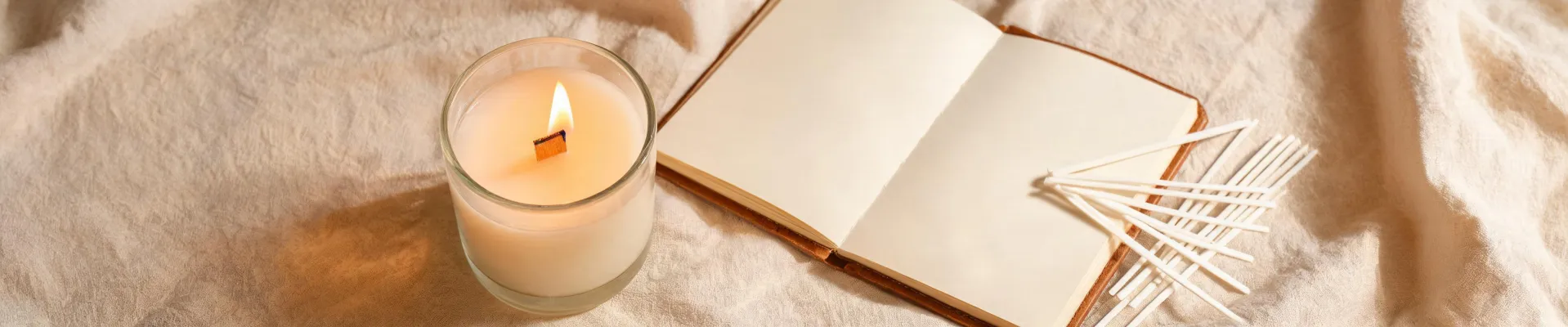
If you've searched for woodwick candle wick, you probably want to know what the deal is. The wick is made of wood, not cotton. It burns with a soft crackle, like a tiny fireplace. That sound is the product. It's a five-second sensory cue that separates it from every candle with a white cotton wick.
If you've searched for woodwick yankee candle, you're not confused. WoodWick and Yankee Candle are part of the same parent company. That's why they show up together. But WoodWick has its own personality, and for corporate gifting that personality matters. The crackle makes people pay attention.
Here's something I learned the hard way: the wood wick needs to be trimmed to about 1/8 inch before each burn. If it's too long, it smokes and crackles unevenly. So when you send a WoodWick as a gift, include a one-line note: Trim wick to 1/8 inch before lighting. That note turns a potential disappointment into a ritual. It's also the kind of detail that makes a branded gift feel thought through.
In Q3 2024, I compared WoodWick against six other candle suppliers using our TCO spreadsheet. The unit price was higher. The shipping weight is higher too. On paper, a standard candle will beat it on cost every time. But a standard candle loses the crackle. And the crackle is the reason people keep it.
Pricing: a 10-ounce WoodWick jar candle sits in the mid-$20s at major retailers as of January 2025. That is not a budget-line swag item. It's a gift. If your internal average gift cost is under $12, WoodWick is probably not the right choice. If you're comparing it to a $6.80 holiday figurine, stop comparing unit prices. Compare how many of each survives the first week.
What I'd Actually Buy (and What I Wouldn't)
Here's the honest part, because there is no such thing as the perfect corporate gift. There's only the right gift for the right relationship.
I recommend WoodWick for:
- Client end-of-year thank-you gifts, when the relationship has a real person attached.
- Employee milestone gifts like five-year anniversaries.
- Small batches of high-touch gifts for your top 50 accounts.
I do not recommend it for:
- Conference giveaways where the goal is logo impressions.
- Any order where the target cost is under $12 per recipient.
- Environments that restrict open flames or fragrance.
If you're in a fragrance-restricted setting, don't force a candle to work. A premium journal or a branded desk accessory might be safer. Honesty about limitations is what keeps your next recommendation trustworthy.
I went back and forth between WoodWick and a cheaper candle for a client gift order last year. On paper, the cheaper candle saved us 35%. But my gut said the crackle was the whole point. I chose WoodWick. The client's CEO mentioned the sound in a follow-up call. That doesn't happen with a tea set.
The surprise wasn't the price difference. It was how much the crackle changed the reaction. The candle gets lit. The tea set gets packed away. The holiday figurine gets a nod and a dusting. (Not that packed away is the end of the world—it's just a waste of budget.)
And for the points question: yes, points can usually be redeemed for branded merchandise. But run the total cost before you pick the item. The points are just the currency. The emotional response is the return.
Bottom line: the problem isn't that you don't know how to choose gifts. The problem is that you're choosing before you've defined the goal. Define the relationship, then pick the product. You'll save money, respect the recipient, and maybe—just maybe—get a thank-you email that isn't auto-generated.

Elise Laurent
Elise Laurent is a crystal and decorative glass quality analyst covering crystal figurines, vases, ornaments, suncatchers, and gift glassware. She examines ISO 6486-1 where food-contact glass dinnerware applies, then uses polarized strain inspection, dimensional checks, surface-defect grading, and refractive clarity to compare decorative pieces outside that scope. Her work helps sourcing teams choose materials, finishing routes, and protective packaging without confusing visual brilliance with verified durability.