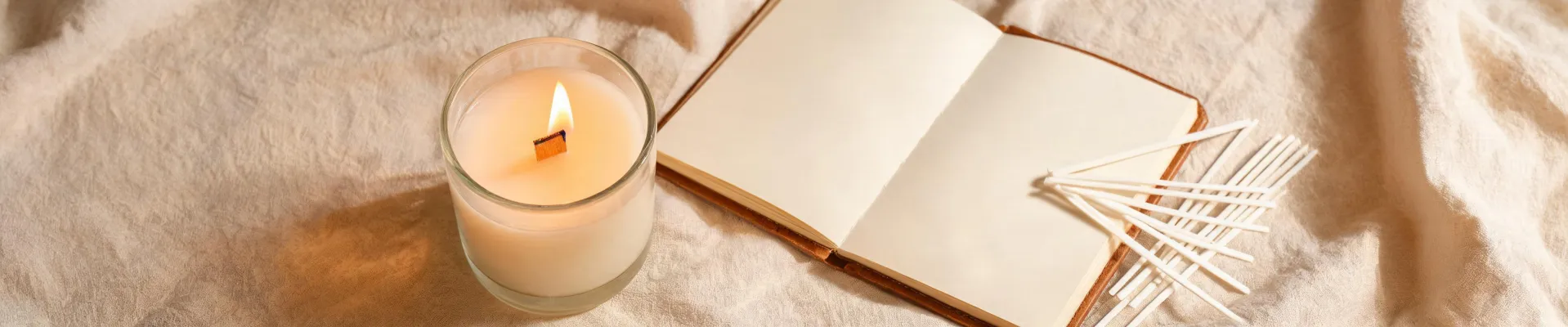
I Ordered Thousands of WoodWick Candles for Corporate Gifts. These 4 Mistakes Cost Me Real Money
2026-08-28 / Elise Laurent
-
Conclusion: The Candle Is Fine. The Details Around It Are Where Budgets Die.
-
Why You Should Trust My Disaster Log
-
Mistake #1: I Assumed People Knew What a Wooden Wick Was
-
Mistake #2: The Candle Holder That Didn't Fit (My Most Expensive Mistake)
-
Mistake #3: Branded Merchandise on Amber Glass
-
Mistake #4: The Nativity Set With No Instructions
-
The Pre-Order Checklist I Use Now
-
When You Can Skip This Checklist (and When You Really Can't)
Conclusion: The Candle Is Fine. The Details Around It Are Where Budgets Die.
If you're buying WoodWick candles as corporate gifts, the product itself is rarely the problem. The problem is everything around it: wrong candle holder sizing, missing wick instructions, logo colors that vanish on amber glass, and the quiet assumption that a multi-piece gift will explain itself. In September 2023, I watched a 1,200-piece order of WoodWick fire candle gift sets get rejected because the candles were leaning in their holders. That mistake cost $1,850 in redo material plus a 1-week delay. Since then, we've caught 38 potential errors using a pre-order checklist that takes about 30 minutes to run. The lesson is simple: the candle is usually fine; the details around it are where budgets die.
Why You Should Trust My Disaster Log
I'm a procurement coordinator handling corporate gift orders for six years. I've personally made and documented four significant mistakes, totaling roughly $4,300 in wasted budget. Now I maintain my team's pre-order checklist to keep other buyers from repeating my errors. This isn't a theoretical article about best practices. It's the short version of a log I keep after one too many late nights peeling labels and apologizing to clients.
Mistake #1: I Assumed People Knew What a Wooden Wick Was
First big error: I thought a WoodWick fire candle was self-explanatory. It isn't. I've stood at corporate gift trade shows and heard a procurement manager ask, 'how to make WoodWick candles?' People hear 'wood' and assume it's a rustic DIY project. The truth is the wooden wick is engineered: the wood species, the thickness, the groove pattern, all affect the crackle. Making wood-wick candles at home is a very different project. When you gift a WoodWick candle without explaining the wick, some recipients will light it wrong, smell smoke, and blame the brand. We now put a small card in every gift set: 'Trim the wick to about 1/8 inch before lighting. The crackle is supposed to sound like a fireplace.'
Mistake #2: The Candle Holder That Didn't Fit (My Most Expensive Mistake)
Mistake number two is the one that actually hurt. We sourced a candle holder from a different supplier because the client wanted something more premium than the standard sleeve. The holder looked fine in the supplier's photo. But the inner lip of the holder was 0.25 inches narrower than the WoodWick jar's base. When we placed the jar into the holder, it didn't drop down. It sat on an angle. Every single candle in the 1,200-piece order looked like it was leaning.
Had 2 hours to confirm the order before the client's PO expired. Normally I'd get a physical sample first, but there was no time. Went with the supplier's measurements based on trust alone. In hindsight, I should have pushed back on the timeline. The supplier's email said 'approx. 9 cm,' which in the real world means 'somewhere around 9 cm.' We needed 8.6 cm. That's basically how a $6,000 order became an $8,100 order. The most frustrating part? The same kind of mismatch keeps happening across the industry. You'd think written dimensions would prevent it, but 'approx' means different things to different people. For context, a single WoodWick candle retails for around $22–$26 at major online retailers as of January 2025; that's based on publicly listed prices I checked before writing this. In bulk, the unit price drops, but a mistake multiplies.
Mistake #3: Branded Merchandise on Amber Glass
Third mistake was basic, but it catches a lot of people because they look at a digital mockup on a white background. We printed a client's dark navy logo directly onto the amber glass jar of a WoodWick candle. On screen, you could read it fine. On actual glass, the logo disappeared like text on a bruise. We didn't catch it until the first 500 labels were applied. That's $640 in wasted labels plus two days of peeling. If you're putting branded merchandise on a product with colored packaging, do a physical test, not a desktop check.
Mistake #4: The Nativity Set With No Instructions
Fourth mistake taught me that instructions are part of the product, not an afterthought. A client asked for a premium holiday gift: a WoodWick candle paired with a small ceramic nativity set. We sourced a beautiful 9-piece set, but it arrived with no assembly guidance. We assumed a nativity set is obvious. It isn't. We got emails from recipients asking 'how to set up the nativity set?' Specifically, which piece goes in the back, how the stable pieces connect, and whether the baby should be placed before Christmas Day. We had to create a one-page PDF with photos and email it to every recipient. That was a 3-day distraction in the middle of peak shipping season.
So glad we caught the issue before shipping the full batch—we almost sent 300 boxes with no instructions. Honestly, a nativity set with no instructions is a support ticket generator. If the product has more than one piece, include a diagram. Even better, make the diagram part of the inside packaging so people don't have to search for a PDF.
The Pre-Order Checklist I Use Now
If you're handling a bulk order of WoodWick candles, personalized candle holders, or anything with pieces, this is the list I wish I'd had in September 2023.
- Measure the actual jar, holder, and outer box — not the specs from the website. Ask the supplier to send you physical dimensions in centimeters and inches. 'Approx.' is not a dimension.
- Request a physical sample of the complete assembled gift. If you're combining a candle, holder, and branded insert, approve the assembled unit, not the separate components. This would have caught the leaning jar and the invisible logo.
- Write the wick instructions on the label or in a card. For a WoodWick fire candle, the wooden wick is a feature, but only if people know how to use it. Short and explicit: 'Trim to 1/8 inch. Light. Enjoy the crackle.'
- Assume nothing about multi-piece products. If you're including a nativity set, a puzzle, or even a candle holder with an insert, ask yourself: 'Could someone search how to set up the nativity set and end up in my support inbox?' If the answer is yes, include instructions.
- Test your logo on the actual material. Amber glass, matte black lids, and kraft boxes all change how colors read. A white-background mockup is fine for a first draft, not for a production approval.
- Build in a buffer for supplier interpretation. Most suppliers do good work, but 'good' means different things. If you leave 24 hours before your deadline, that's not a buffer; that's a countdown. (Mental note: I really should update our supplier spec sheet with this exact list.)
When You Can Skip This Checklist (and When You Really Can't)
If you're ordering 20 candles for a small team, you don't need all of this. One quick look at a physical sample and a printed instruction card will cover 90% of the risk. The full checklist matters more at 100+ pieces, where the cost of a mistake multiplies. Also, the 'make your own wood-wick candle' route deserves its own essay. If you're tempted, it's not a craft project. It's a manufacturing process with sourcing, quality control, and wick design decisions. If you ask me, that's a supplier's job, not a gift buyer's job.
One more honest boundary: this is based on orders I ran in 2023 and 2024. As of January 2025, at least, the fundamentals haven't changed: measure, sample, test, explain. Suppliers change their packaging and lead times often enough that last year's dimensions might not be this year's reality. What was best practice in 2020 can probably be improved in 2025; some basics, like checking the physical fit, will never go out of style.

Elise Laurent
Elise Laurent is a crystal and decorative glass quality analyst covering crystal figurines, vases, ornaments, suncatchers, and gift glassware. She examines ISO 6486-1 where food-contact glass dinnerware applies, then uses polarized strain inspection, dimensional checks, surface-defect grading, and refractive clarity to compare decorative pieces outside that scope. Her work helps sourcing teams choose materials, finishing routes, and protective packaging without confusing visual brilliance with verified durability.