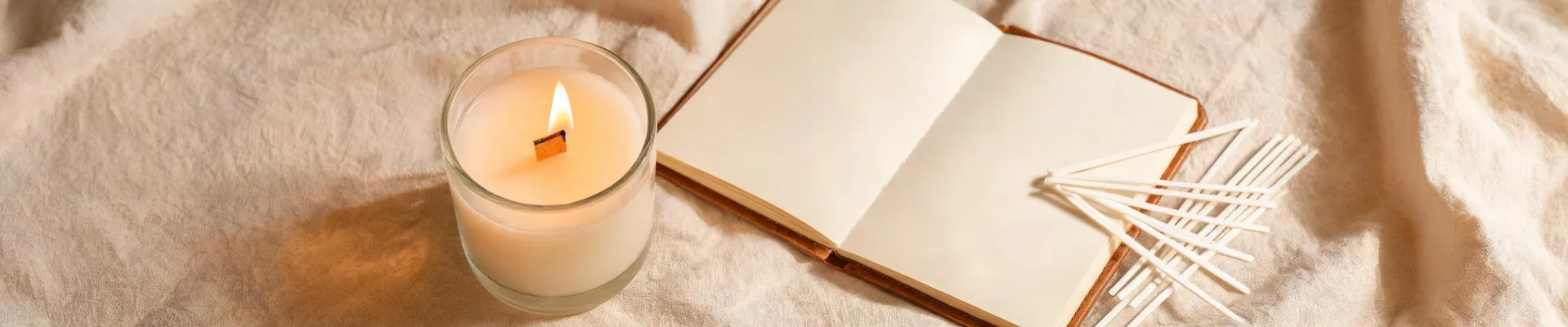
How Long Does a WoodWick Candle Last? Burn Times, Petite Jars, and Promo Distributor Lessons from 400 Gifts
2026-09-08 / Elise Laurent
-
Why I Keep Ordering WoodWicks
-
How Long Does a WoodWick Candle Last?
-
Does the WoodWick Petite Candle Make Sense for Corporate Gifts?
-
Candle Holders and Christmas Ornaments in the Gift Box: Do They Add Value?
-
So What Is the Best Promotional Products Distributor?
-
When a Lower Quote Is Actually the Right Call
You're probably here because you asked Google how long a WoodWick candle lasts, whether the WoodWick petite candle is a smart buy for a gift budget, or what the best promotional products distributor actually is. I don't have a lab and I don't have a listicle. What I have is a purchase ledger: since 2021, I've bought just over 400 WoodWick candles for corporate gifts at the company where I manage purchasing.
Here's the short version. A medium WoodWick jar burns somewhere in the 30–40 hour range with reasonable care; the petite is closer to 10–15 hours; and the “best” promotional products distributor is not the one with the lowest quote — it's the one whose quality, delivery and invoicing hold up when something goes wrong. That last sentence is the expensive lesson, and the rest of this article is about how to avoid paying it again.
Why I Keep Ordering WoodWicks
By way of background: I'm the office administrator for a 180-person professional-services firm. That means I own the corporate gift program, among other things — holiday gifts for clients, recruiting gifts, speaker thank-yous, and the occasional “can we have 200 boxes by Friday” request. In a typical year, I process 60–80 orders across 8–10 vendors. The candle line isn't the biggest dollar amount, but it's the one people actually mention when they say thank you.
I'm not a candle scientist. I'm a buyer who has watched what happens when a gift order goes right and when it goes sideways. After 400+ candles and a fair number of follow-up conversations, I trust the patterns more than the brochure copy.
How Long Does a WoodWick Candle Last?
If you only need the number: figure 30–40 hours for the medium jar and 10–15 hours for the petite. Large jars run longer, but those two are the ones corporate buyers tend to order.
The label number assumes the candle is being burned correctly, and that's where most people lose burn time. Tunneling is the biggest culprit. If the first burn doesn't soften the wax all the way to the edges of the jar, the candle burns a hole down the middle and leaves a ring of wax behind. A “35-hour” candle can end up delivering less than 20.
The wooden wick is the second variable. It chars differently from a cotton wick, and if you don't trim it before relighting, the flame gets lazy and sooty. People who would never blow out a candle early suddenly do, because it smells like a fireplace instead of sandalwood.
The National Candle Association's basic safety guidance doubles as a get-the-most-burn-time checklist: burn candles no more than four hours at a time, trim the wick before each relight, keep the wax pool clear of wick debris, and stop when roughly half an inch of wax remains. Do that, and the label's number starts to feel real.
I don't have hard data from a controlled test of all 400 candles. What I can tell you anecdotally is that our internal burn test of two medium jars and three petites in 2024 matched the bottom of the label ranges, not the top. Budget your cost-per-use around the lower number and you won't be disappointed.
Does the WoodWick Petite Candle Make Sense for Corporate Gifts?
The WoodWick petite candle is easy to dismiss as the “small” option, but it serves a specific corporate role. For internal employee gifts, event attendee bags, trade show giveaways, or a client's first introduction to the brand, a petite is enough. It offers the same crackling wooden wick and scent range with a much easier price point.
What it isn't is a substitute for a medium jar when the relationship matters. If a candle is meant to say “thanks for a great year, we'd like to keep this account,” the petite reads thoughtful but small. The medium jar reads like a gift. There's a fine line between being seen as careful with your budget and being seen as cheap. In my experience, key accounts should get the larger jar. Petites should be reserved for the broader list.
Also, petites are a great way to test scents before committing to a large order. We asked our distributor for a petite in each new fragrance we were considering and burned them over a week. That test cost less than one medium gift box and saved us from choosing a scent that the whole office hated.
Candle Holders and Christmas Ornaments in the Gift Box: Do They Add Value?
The candle holder question comes up every time we design a holiday box, and my answer surprises people: for a WoodWick jar candle, skip the candle holder unless there's a specific reason to add one. The jar is already its own vessel. Adding a generic holder frequently adds cost, freight weight, and clutter. If you want a base for presentation, choose an open tray or trivet that lets air move around the jar. Avoid enclosed lanterns; a glass jar inside an enclosed holder can trap heat, which is a safety risk I won't take with a client's name on the label.
The Christmas ornament deserves a more careful answer. In 2023, we tested a gift box with a WoodWick petite, a ceramic candle holder, and a branded glass Christmas ornament. It looked beautiful. It cost about $18 per box, and assembly ran seven minutes per box. What we learned from recipients: the candle was the memory; the holder was neutral; the ornament was only valuable when it marked a milestone. A generic glass ball with a logo goes in the January donation bin.
Now our formula is simpler. If we include a Christmas ornament, it has to say something about the year, the client's project, or our company's anniversary. If it doesn't, we leave it out. And we never put a heavy jar and a fragile ornament in the same compartment of a gift box. Split the inserts or skip the ornament entirely.
So What Is the Best Promotional Products Distributor?
The honest answer is that there is no universal best promotional products distributor. The distributor who handles printed hoodies well is not automatically good at shipping breakable candles. The one with the largest catalog may not be the one who returns your calls in December. Instead of a company name, I'll give you a filter.
Green flags are easy to spot once you know them. A good distributor offers a sample or proof before you commit. They ask how the gift will be used, not just how many you need. They confirm a delivery date in writing and commit to telling you early if it slips. They have a written policy for damage replacements. Their invoice matches your purchase order, with enough line-item detail for a finance team to process without a follow-up email.
Red flags are also easy to spot. The price is dramatically below others. They promise anything is customizable but cannot show the exact product. They treat “damaged in transit” as your problem. They say “we are the best” rather than showing you why.
One story sums up why I care. In 2022, I got a quote about $2.40 lower per candle than our usual distributor. On a 350-candle order, that was a meaningful $840 saving. I already had a policy that we verify with a sample, but we were near the holiday shipping deadline and I overrode it. The cartons arrived late. Fourteen jars were damaged, the vendor directed me to file a freight claim, and their invoice was not itemized, so finance rejected it. I still kick myself when I think about the hours I spent explaining that decision. The $840 saving disappeared into replacement shipping, my time, and a finance team's patience. Spending the extra $2.40 would have been the cost-effective choice.
That's the real argument for value over price. The cheapest quote wins only if you also account for freight, assembly, breakage, rush fees, and the time it takes to fix a problem. In corporate gifting, what you pay per candle is a small part of the total cost. What matters is whether the right candle arrives on time, looks right, and has an invoice your accounting department can approve.
When a Lower Quote Is Actually the Right Call
Value over price doesn't mean “always spend more.” It means doing the math. There are situations where the low quote is fine: internal employee events, high-volume trade show giveaways, or a first small trial with an audience that isn't brand-critical. If a candle is going to be one of 20 items in a conference swag bag, the recipient's memory will not live or die by the wick.
There's also a boundary that has nothing to do with the distributor: not every recipient can burn a candle. For our 2024 holiday client list, we switched sixty recipients to WoodWick reed diffusers because their offices or apartment buildings restrict open flames. We didn't learn that from a price sheet; we learned it by asking the contacts ahead of time. It saved us from sending lovely gifts that would have gone straight into a drawer.
If you're planning a holiday candle order, buy one WoodWick now and burn it at home for a few evenings. Watch how the wick behaves, how the scent fills the room, and how long the jar actually lasts. Then you'll have the one piece of data that matters when you talk to a distributor: a reference point from your own desk, not a label.
(Note to self: finally write that vendor scorecard into a checklist before the next buying cycle. This article is a good start.)

Elise Laurent
Elise Laurent is a crystal and decorative glass quality analyst covering crystal figurines, vases, ornaments, suncatchers, and gift glassware. She examines ISO 6486-1 where food-contact glass dinnerware applies, then uses polarized strain inspection, dimensional checks, surface-defect grading, and refractive clarity to compare decorative pieces outside that scope. Her work helps sourcing teams choose materials, finishing routes, and protective packaging without confusing visual brilliance with verified durability.