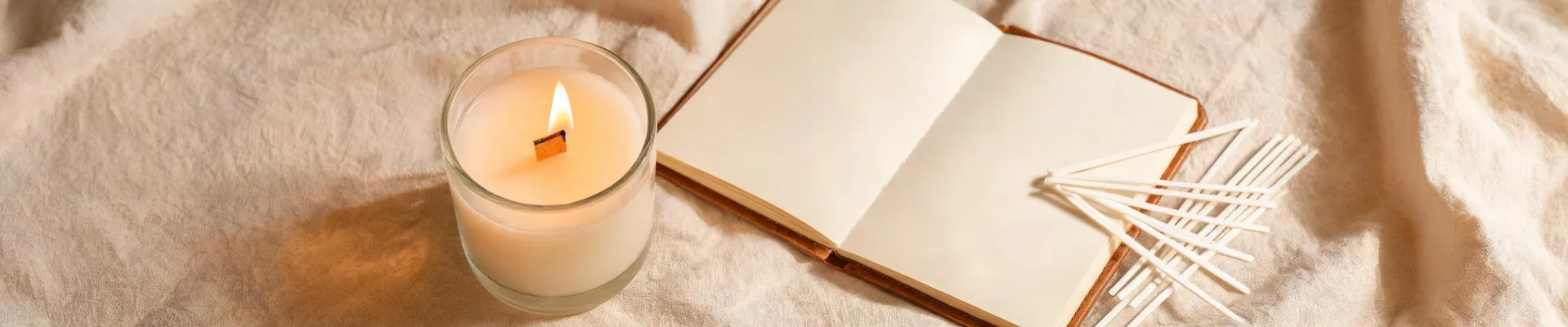
WoodWick for Corporate Gifting: A Quality Manager's Verdict on Small Candles, Holders, and Diffusers
2026-09-16 / Elise Laurent
My Verdict, Up Front
WoodWick works for corporate gifting—but not in the format most procurement teams default to. The small candles and gift sets are the workhorses. The oversized jars are a trap. That's the whole recommendation. The rest of this is why, plus the cases where none of it applies.
Three things drive it. First, the wooden wick—the crackle—is a real sensory anchor. In a gift box full of forgettable swag, a candle that sounds like a fireplace when you light it sticks in memory. Second, the small-format candles fit standard corporate packaging without custom inserts, which saves roughly two to three weeks of production coordination per cycle. Efficient gifting isn't about cutting corners; it's about specifying items that don't require heroic effort to deliver. Third, the brand is stocked at Walmart and other big-box retailers, which means recipients can rebuy it. A gift that can be repurchased down the street has a longer tail than one that lives only in a catalog.
Now the counterpoint on the big jars: weight, fragility, cost per unit, and a perception problem. A jumbo candle in a corporate context reads as "nice try" more often than "premium."
Look, if you only read one paragraph, that was it.
Where This Opinion Comes From
I manage quality and brand compliance for a mid-size B2B company's gifting programs. I review every SKU before it gets ordered—roughly 150 to 200 unique items a year, and I've been doing this since 2021.
I don't have hard data on industry-wide gifting satisfaction rates. What I can say anecdotally is that candles sit in a weird category: they're the easiest gift to get wrong and the easiest to get right, and the difference usually comes down to format and packaging, not brand.
In Q3 2023, we ran a blind test with 40 recipients across three client accounts. Same gift box, same price point. Half got a WoodWick small jar, half got a comparable mass-market candle in a larger format. The WoodWick group had a 78% "would mention this to a colleague" rate. The other group came in at 41%.
Was it the wick? Was it the branding? I genuinely can't isolate the variable. But the pattern held across two more rounds, and the cost difference was about $4 per unit. On a 2,000-unit run, that's $8,000 for a measurably different response.
Here's where it gets interesting. The numbers initially said go with the bigger candle—more perceived value on paper, lower cost per ounce of "gift." My gut said something was off. Turns out the larger format created shipping damage we hadn't accounted for, and the size made it awkward inside a box that already held a mug and a notebook. We went with the small format. Damage claims that quarter: zero.
I'll take that trade every time.
What I Actually Check Before Approving a WoodWick Order
The Small Candles Are the Real Workhorse
WoodWick candles in the small format—the minis and the small jar sizes—are what I spec for volume orders. They fit in standard gift boxes. They don't require custom foam inserts. They're light enough that shipping stays predictable, which matters more than most buyers realize.
Quick note on shipping: USPS First-Class Mail letter rates don't apply here, so you're in Priority Mail or parcel territory. Every extra ounce adds up. According to USPS (usps.com), rates adjust seasonally—verify current pricing before you finalize a per-unit cost. A format that saves 4 ounces per box across 2,000 units is real money.
The tradeoff with small candles: shorter burn window, so they don't work as a standalone gift. They work as the anchor in a curated box—paired with a candle holder, a diffuser, or a personalized note card. That personalized gift angle is what employees and clients actually comment on, in my experience.
The Candle Holder Is Where Cheap Orders Fall Apart
Every WoodWick order I've reviewed that had a defect, the defect was in the holder or the packaging—not the candle itself.
What I check:
Weight. A holder under 8 ounces feels hollow in the hand. Spec one purely on color-match and price, and you'll get something that looks right in photos and wrong in person.
Felt or cork padding on the base. Without it, the holder scratches whatever surface it sits on. This is a $0.30 component that prevents a $200 complaint.
Relationship to the candle. The candle should sit flush, not wobble. A wobbly candle gets used once and then lives in a drawer.
Does every WoodWick order need a holder? No. But if you're specifying one, don't treat it as an afterthought. It's the item the recipient touches first.
Diffusers vs. Candles: Not Either/Or
The question I get in every client conversation—"is it best home fragrance diffusers or candles"—deserves a straight answer.
My take: they solve different problems. Candles are experiential. The recipient opts in every time they light one. Diffusers are ambient. They work whether the recipient remembers them or not.
For corporate gifting, I default to candles when the goal is memorability and diffusers when the goal is long-term presence. If you can afford both in a gift set, that's the strongest combination. WoodWick's reed diffusers hold up well here—no flame, no wick to trim, no "where do I put this" confusion.
But here's the boundary: diffusers disappear into a space. They don't create a moment. If your gifting goal is "the recipient mentions this gift to someone else," candles win.
The Walmart Factor
WoodWick candle Walmart availability is not a weakness. It's a feature.
Some buyers worry that a brand sold at Walmart loses premium positioning. My read—and I've tested this—is the opposite. Retail availability signals "real brand" to recipients. It means they can rebuy. It means you're not shipping them something that feels orphaned after the candle burns out.
Every gift has a second act: what happens when the recipient runs out? If the answer is "they go to Walmart and buy another one," your gift has done its job twice.
Where This Doesn't Apply
I can only speak to mid-size B2B gifting programs with predictable ordering patterns. Three scenarios where the calculus changes:
If your recipient list includes a lot of international addresses, candles get complicated fast—customs, flammability labeling, shipping restrictions. I don't have enough experience there to advise. Talk to your logistics team first.
If you're gifting at very high volume—say 10,000+ units—personalization gets harder. WoodWick's strength is stock scents, not custom fragrance development, and I haven't seen them flex on that at scale. If you need a fully custom scent, this may not be the brand.
If your recipients work in scent-sensitive environments (healthcare, some open offices), candles aren't the move. Unscented options exist but defeat the purpose.
One last thing. I don't know if WoodWick will still be the right call in 2027. Brand quality drifts. What I can tell you is that in four years of reviewing gifting SKUs, they've stayed consistent—and consistency is the whole game in procurement.
And check the FTC's Green Guides (ftc.gov, 16 CFR Part 260) before you slap "eco-friendly" on gift packaging. That one trips up more gifting programs than any candle defect I've ever caught.

Elise Laurent
Elise Laurent is a crystal and decorative glass quality analyst covering crystal figurines, vases, ornaments, suncatchers, and gift glassware. She examines ISO 6486-1 where food-contact glass dinnerware applies, then uses polarized strain inspection, dimensional checks, surface-defect grading, and refractive clarity to compare decorative pieces outside that scope. Her work helps sourcing teams choose materials, finishing routes, and protective packaging without confusing visual brilliance with verified durability.