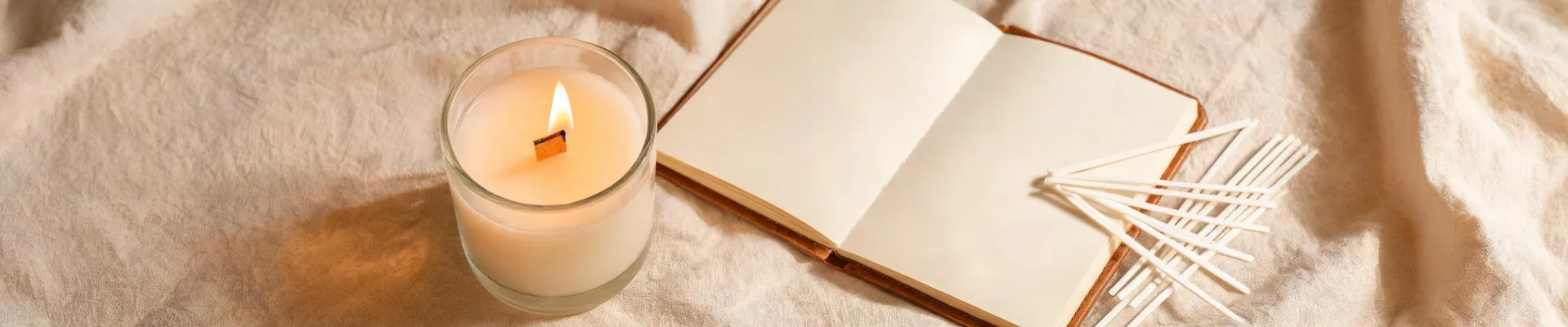
What Corporate Gift Buyers Miss When They Search the WoodWick Official Website
2026-09-16 / Elise Laurent
Every October, the searches start. "Woodwick official website." "Personalized gift." Then, around late November, "holiday figurine." And sometimes, from someone who has clearly given up on procurement and wandered into craft forums: "what can you do with cross stitch when finished."
Stay with me. That last search is more relevant than it looks.
From the outside, rushed corporate gift orders look like logistics problems. By the time I'm involved, the deadline is near, the budget has moved, and the product is always something that seemed right in a search result. But the real problem isn't speed. It's that the search started too late—in a very particular way.
Searching Feels Like Progress
Tell me if this sounds familiar. Someone finds a candle with a crackling wooden wick. The team agrees: candles are premium, useful, and on-trend. Then someone says, "Can we get a Woodwick beeswax candle instead?" No one fact-checks that phrase. Then someone else mentions a holiday figurine as a second gift. Product discovery feels like problem solving.
Here's the uncomfortable part: product research is procrastination. It's easier to compare four candle jars than to ask, "What's the last possible date we can approve a label proof?"
Wait. "WoodWick" Is Not a Wax Recipe
Let's clear one thing up before it becomes a procurement problem. WoodWick is a brand name, and a wooden wick is a type of wick, not a wax source. A "Woodwick beeswax candle" is not a product category. If you want a beeswax candle with a wooden wick, you need to specify that—and you need the wax content on the spec sheet.
Why does this matter for corporate gift buyers? Because rushed orders are exactly when documentation gets skipped. Fragrance oils need IFRA statements. Ingredients need plain language. And "natural" or "pure" claims need evidence. Federal Trade Commission guidance (ftc.gov) is blunt: every claim must be substantiated. That paperwork can take longer than production, and it can't be ignored just because marketing already promised your boss the candles are "clean."
It's also why reading the brand's actual collections matters. If you start on the WoodWick official website, you see the range: jars, wax melts, reed diffusers. Some gifts don't need an open flame at all.
The Personalization Trap
Then there's "personalized gift." A buyer puts a recipient's name on a candle, a company logo on a box, and a date on a glass jar. They call it personalization.
No. A gift that has been stamped is not a gift that has been personalized.
Real personalization means the recipient uses it and thinks, "Someone actually pictured me using this." Maybe the scent matches a room. Maybe the message is private, not a corporate greeting. Maybe it's a no-flame wax melt because this particular recipient works in a building that doesn't allow candles. That takes a little extra effort. It also takes time.
The Cross-Stitch Test
Which brings us back to "what can you do with cross stitch when finished."
Search results will tell you: frame it, put it in a hoop, make it into a pillow, turn it into an ornament, sew it on a tote. The point is that finishing the stitching is only half the project. The finished object still needs to become something that belongs in a life.
Cross-stitch isn't done until it has a place to live. A corporate gift isn't done until it has a use.
A holiday figurine is a different kind of gift. It can be charming and meaningful. But it depends on the recipient's taste, storage space, and holiday decorating style. A scented candle has lower aesthetic risk. It doesn't ask to match a shelf. It asks to be lit.
The Real Timeline Problem
In my role coordinating branded candle orders, I can tell when a project is about to go sideways. It's usually not the supplier's fault. It's because the word "production" hid three different lead times.
First, product lead time. Do you have stock, or is it made to order? Second, personalization lead time. Labels, etching, hang tags, gift boxing. Third, compliance and approval time. Fragrance certificates, ingredient declarations, final proofs, the legal review that someone didn't realize they needed.
There is also a fourth timeline that doesn't happen in the factory at all: delivery. A B2B holiday order isn't one delivery. It's one box to a head office, 40 individual shipments for remote staff, and a smaller rush order for the team that just added four people. The "order date" means nothing if the address list is late.
Here's one example. In March 2024, a customer called at 4:00 p.m. for a 120-candle order that had to arrive in 48 hours. They had a budget. They had artwork. They hadn't approved the final proof. The label shop quoted $180 to turn a five-day job around in two. We paid. The order arrived. But the total cost went from $1,480 to about $1,840—and that doesn't count the late night spent checking every box.
Last quarter, our team processed 47 rush requests. Most were fine, honestly. The problems came from a specific pattern: decisions that should have been made while there was still time were made exactly when time ran out.
The Cost of Letting It Ride
The real cost of a late gift program is not express shipping. It's what shipping speed forces you to overlook.
- If you send 300 candles without checking restrictions, some recipients won't be able to burn them.
- If you add a holiday figurine that matched the theme but not the recipient, it becomes another thing to store.
- If you buy from a seller who is vague about wax and wick sourcing, your brand absorbs that risk. So does your client's trust.
- If you skip a physical label proof, you might approve a text error at 11:00 p.m. and see it printed on 300 boxes.
That last one happened to us. The proof looked fine on a screen. In person, the color was wrong and the label was nearly unreadable against the jar. We reprinted, paid for duplicate shipping, and learned to build a 48-hour approval buffer into every job. A gift that arrives but feels off can do more damage than a gift that arrives late.
A Better Way to Plan the Same Gift
The fix isn't exotic. It requires starting from the end.
Before you search the WoodWick official website again, or compare one holiday figurine to another, map the project backwards:
- When do the gifts actually need to arrive?
- What will the recipient do with them?
- What personal touch—scent, message, format—actually fits this person?
- What documentation do you need before you can print a claim like "pure" or "natural"?
Then subtract the production time, delivery time, the approval process, and a buffer week for whatever you didn't predict. That buffer isn't luxury. It's the difference between catching a mistake and explaining one.
And if you're testing a new gift idea, start small. A 50-unit order can tell you more than a brochure ever will. A vendor who treats that first small order carelessly probably won't get better when 500 units are on the line.
Wooden-wick candles remain a strong corporate gift option. The crackle gives people something to talk about, the scent gives them an immediate reason to light it, and the format gives you a lot of personalization options. But the candle is only part of the project. The deadline, the documentation, and the recipient's context are the real gift.
Because by late December, someone will definitely be searching "what can you do with cross stitch when finished." It shouldn't be your logistics manager.

Elise Laurent
Elise Laurent is a crystal and decorative glass quality analyst covering crystal figurines, vases, ornaments, suncatchers, and gift glassware. She examines ISO 6486-1 where food-contact glass dinnerware applies, then uses polarized strain inspection, dimensional checks, surface-defect grading, and refractive clarity to compare decorative pieces outside that scope. Her work helps sourcing teams choose materials, finishing routes, and protective packaging without confusing visual brilliance with verified durability.