How to Inspect WoodWick Candles and Home Fragrance Gifts Before a Corporate Order
2026-08-27 / Elise Laurent
-
Why I Reject 4% of First Deliveries
-
Step 1: Check the Vessel Before You Check the Scent
-
Step 2: Listen to the Wick, Especially a WoodWick
-
Step 3: Solve the 'Can't Smell Reed Diffuser' Problem Before It Happens
-
Step 4: Burn Past the Halfway Point
-
Step 5: Read a Seasonal Scent as a Formula, Not a Name
-
Step 6: Verify Labels and Certificates Before You Approve
-
Bottom Line: Unit Price Is Not Total Cost
Why I Reject 4% of First Deliveries
I'm the quality and compliance manager for a home fragrance company. That sounds more official than it is. My day mostly consists of burning candles in a vented room, sticking my nose into jars, and telling vendors 'not yet' more often than they'd like.
Every quarter I review roughly 200 home fragrance products—jar candles, votive candle styles, wax melts, reed diffusers—before we put them in front of corporate buyers. In our Q1 2024 quality audit, I rejected 4% of first deliveries because of problems that would never show up in a product photo.
If you're sourcing candles for corporate gifts, client thank-yous, or employee milestone kits, this is the checklist I use. It doesn't cover every piece of fragrance chemistry—I'm not a perfumer. But it will keep you from learning some expensive lessons that only show up after the product leaves your warehouse.
Step 1: Check the Vessel Before You Check the Scent
The jar or tin is what people see first. But I'm more interested in how it holds up in a warehouse than how it looks on a conference table. I put every sample through a 'shipping test': lid on, label cured, box held at 85°F for 24 hours. If the label wrinkles, the lid sticks, or the wax sweats, that's a fail.
For a votive candle, the holder rules are different. Votives need a snug enough holder or the pool of melted wax can get too hot. If you're gifting a votive by itself, prepare for people to use it in a random glass dish or not use it at all. A well-made wax melt in a simple tin is often a better low-cost gift option than a bare votive—not because votives are bad, but because the recipient usually has to buy extra equipment.
Step 2: Listen to the Wick, Especially a WoodWick
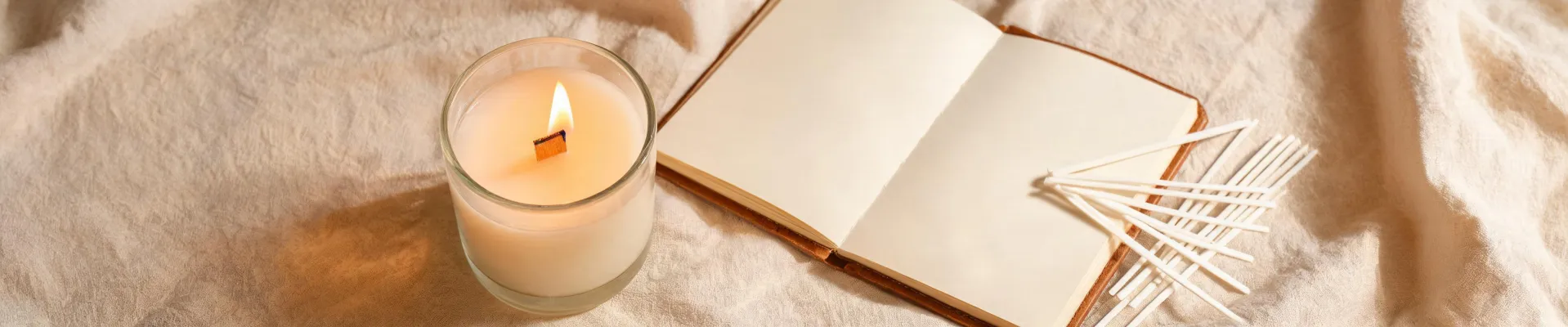
A wooden wick isn't just a visual feature. It creates the crackle that makes the candle feel like a fireplace. But it also introduces quality issues you won't see in the first two hours. I check three things:
- Wick centering. An off-center wick causes uneven burning. On a wooden wick, that can mean one side curls into the wax and drowns.
- Wick thickness. A wick that's too thin for the jar diameter makes a weak crackle and a shallow melt pool. Too thick creates soot.
- Second-half burn. More on this below.
If a client asks for a cozy, warm option, I usually point them to the cashmere WoodWick candle. It has that soft, slightly sweet dry-down that reads as comfortable without being loud. But the scent won't save a wick that was assembled without quality control. Ask the supplier for burn-test photos from the last third of the candle, not the first hour.
Step 3: Solve the 'Can't Smell Reed Diffuser' Problem Before It Happens
The most common complaint I hear from corporate buyers is "I can't smell reed diffuser." In most cases, the product is fine—the setup or the environment is wrong. Reed diffusers need airflow, enough reeds, and time. A diffuser placed next to an HVAC vent with two reeds in a big lobby will barely register.
When I evaluate a reed diffuser, I put it in a roughly 10x12 foot room, use the number of reeds the vendor specifies, and leave it for 24 hours. Then I walk in from outside the room. That tells me whether the product has real throw. If you still can't smell reed diffuser after 48 hours with five or six reeds in a normal-sized room, ask the vendor for the fragrance oil percentage. If the supplier can't tell you how much scent is actually in the bottle, treat that as a red flag.
Step 4: Burn Past the Halfway Point
Most people test a candle for two hours and call it done. The first half of almost every candle looks fine. The second half is where I've seen wicks drift, soot build up, and jars get too hot.
I learned this the expensive way. I knew I should let a sample burn all the way down before signing off on an 8,000-unit order. But the first three hours were so clean that I thought, 'what are the odds?' The odds caught up. At hour five, the wick mushroomed, the melt pool tilted, and the wax started smoking. We had to redo the whole batch. That redo cost us more than the original purchase order.
Same logic applies to wax melts. Heat a sample for two hours, let it cool and re-solidify, then heat it again. If the second melt has no scent, the fragrance load is too low.
Step 5: Read a Seasonal Scent as a Formula, Not a Name
Seasonal names are easy to love. For fall corporate gifts, woodwick candles pumpkin butter is a popular first pick—it's sweet, spiced, and feels like October. But before you order 500 units, ask what the scent actually does after 20 minutes of burning. A pumpkin butter candle with too little fragrance oil can open as cinnamon and vanilla, then fade into hot wax with no pumpkin at all.
I rejected a batch in 2024 for exactly that reason. It passed the cold sniff in the supplier showroom and failed a 45-minute hot throw test in our burn room. The label said 'pumpkin butter,' but the product told a different story.
Step 6: Verify Labels and Certificates Before You Approve
I'm not a regulatory attorney, so I can't speak to every city or country requirement. That's not my lane. What I can say is that false or missing labels are expensive. In a bulk order, labels are part of the product.
- Lead-free wick statement.
- Fire-safety labeling per ASTM F2058.
- Approximate burn time on the package.
- Company name and country of origin.
If a supplier says '100% soy' and can't produce a certificate of analysis, treat that as a red flag. It doesn't necessarily mean they're lying. It means they haven't documented it, and you don't want to pass that claim on to a client without proof.
Bottom Line: Unit Price Is Not Total Cost
I have seen too many buyers choose the lowest quote and then spend the savings on returns, rush replacements, and apologies. A $1.50 per-unit savings on a 2,000-unit order is $3,000. One defective candle that damages a client's wooden table is not a $3,000 problem. It's a reputation problem.
The way I see it, a candle supplier should be able to answer three questions: What percentage of the fragrance oil is in the product? How does it burn in the last third? What is actually printed on the label? If they can't answer those, they're not ready for a corporate order. You shouldn't pay for their learning curve.
This checklist reflects what I've learned as of January 2025. Regulations change, formulas change, and so do fragrance trends. So run your own tests, keep records, and don't trust a sample that looks good in a humid conference room. The goal is not to find the cheapest candle. The goal is to find a candle that won't embarrass your brand after a few days on someone's desk.

Elise Laurent
Elise Laurent is a crystal and decorative glass quality analyst covering crystal figurines, vases, ornaments, suncatchers, and gift glassware. She examines ISO 6486-1 where food-contact glass dinnerware applies, then uses polarized strain inspection, dimensional checks, surface-defect grading, and refractive clarity to compare decorative pieces outside that scope. Her work helps sourcing teams choose materials, finishing routes, and protective packaging without confusing visual brilliance with verified durability.