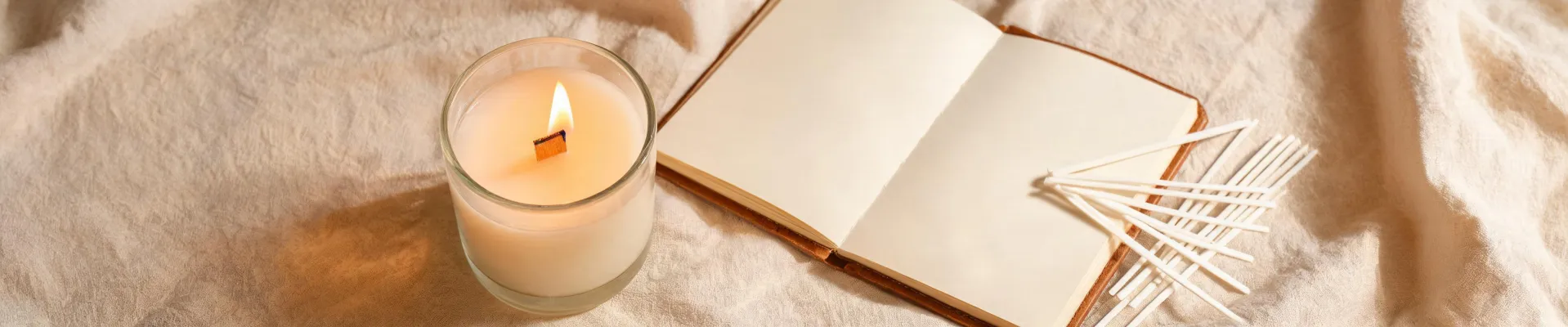
WoodWick vs. Wax Melts vs. DIY Reed Diffusers: A Cost Controller's Comparison for Corporate Gifts
2026-08-12 / Elise Laurent
-
Let's Start With a Fair Comparison
-
The Comparison Framework
-
1. Total Cost: WoodWick vs. Wax Melts vs. DIY Reed Diffusers
-
2. Logistics and Handling
-
3. Safety: Are WoodWick Candles Safe?
-
4. Perceived Value and Brand Fit
-
5. Customization and Branding
-
A Quick Note on How to Make Your Own Essential Oil Reed Diffuser
-
The Bottom Line, From a Cost Controller
Let's Start With a Fair Comparison
Every fall, I sit down with our corporate gift budget and ask the same question: do we buy people something they'll actually keep, or something that just carries our logo? I'm a procurement manager at a 140-person logistics company, and for six years I've tracked roughly $180,000 in promotional and gift spending in one cost-tracking spreadsheet. It includes coffee mugs, towels, candles, and a few mistakes I'd rather forget.
If you're trying to decide between WoodWick candles, wax melts, and making your own reed diffusers, these products are not interchangeable. But they compete for the same line item, so I'll compare them the way I compare suppliers: total cost, logistics, safety, perceived value, and customization. No bias, just numbers and practical experience.
The Comparison Framework
Here's what you need to know before we start: I'm not going to tell you that candles are always better. I've made the mistake of assuming a premium candle is the right gift for everyone. It isn't. The key is matching the product to the recipient's environment and your distribution reality.
For each dimension, I'll give a clear conclusion. If a choice is a trade-off, I'll say so—but I won't hide behind 'it depends' for every answer.
- Total cost per recipient – including hidden costs like labor, shipping, and packaging.
- Logistics and handling – because glass breaks and labels fall off.
- Safety and liability – especially for offices and client-facing gifts.
- Perceived value and brand fit – what the recipient feels when they open the box.
- Customization options – brand colors, labels, and repeatable quality.
1. Total Cost: WoodWick vs. Wax Melts vs. DIY Reed Diffusers
WoodWick candles are not cheap. As of early 2025, from what I've seen at retail, a full-size WoodWick jar can easily land in the $25-$35 range. At Walmart, you can often find WoodWick candles for around $20-$25, which is fine if you're testing a scent. But buying one from a retailer is not your cost path for a corporate order. Once you move to bulk wholesale, the unit price drops, but you still need to store glass jars, protect inventory, and pay for shipping weight.
Wax melts are a different beast. A broad ballpark for custom wax melts is $4-$8 per unit. They have no glass, no wick, and they ship flat. If your goal is to send something to 200 remote employees without blowing the budget, wax melts are hard to beat.
DIY reed diffusers are the wildcard. The materials for a 100-ml bottle can cost as little as $4-$6 per unit. That sounds great until you add labor. In our cost-tracking system, I include staff time. If someone spends two hours blending and bottling 30 units at $25/hour, that's roughly $1.70 per unit in added cost. It can still be a cost win—but only if you have the time, a clean space, and no chance of leakage.
Conclusion: By unit cost, wax melts and DIY reed diffusers beat WoodWick candles. But unit cost isn't the only variable. A $25 candle that sits on a desk for a month can deliver more ongoing recognition than a $6 melt that's gone by Friday.
2. Logistics and Handling
Here's where many gift orders fall apart. WoodWick candles come in glass jars. They look beautiful in photos, but glass jars are heavy and breakable. One holiday season, we ordered 120 candles and didn't spec enough packaging. By the time they arrived, six jars were cracked. That pushed our per-unit cost up by about 10% and created an embarrassing repackaging session.
Wax melts are the easiest to ship. They're small, light, and nearly indestructible. You can put them in a poly mailer or a small gift box without a second thought. Reed diffuser bottles are liquid, so they need leak-proof caps, sealed bottles, and upright orientation. A few drops of oil on a corporate gift box can ruin the entire unboxing—a lesson we learned after ignoring it once. Now we test every new bottle for 24 hours on its side before ordering in volume.
Conclusion: For multi-address shipping, wax melts are a no-brainer. For event delivery where you control transport, WoodWick candles can work. DIY reed diffusers are possible, but only if you build a testing step into your process.
3. Safety: Are WoodWick Candles Safe?
Yes, under normal use and with the label's instructions followed. WoodWick's wooden wick is the main difference from a typical cotton wick. That crackle is charming, but the wooden wick needs to be trimmed to about 1/8 inch before each lighting. If you leave it long, it can flicker and create smoke or soot. That's not a health scare; it's basic combustion. You also should not burn a candle more than 3-4 hours at a time, always on a heat-resistant surface and within sight.
For bulk corporate orders, I always ask the supplier for product compliance documentation and check that the label includes burn instructions. I won't claim every WoodWick candle has the same certification in every batch—so verify it. And include a safety card with each gift if you're sending to clients. It's a small cost, and a missing safety label is a red flag.
Wax melts have a different safety profile: no wick, no flame, but they require a wax warmer. That's an important practical question: does your recipient already own one? If not, you either include a warmer (which raises your cost) or accept that the wax melt will end up in a drawer. Reed diffusers have no flame, but essential oils can cause allergies and are not safe for small children at high concentrations. If you're making your own, label the bottle clearly as 'ambient use only' and include a child-resistant cap if there's any chance a family with small kids will receive it.
Conclusion: Wax melts are lowest risk for offices; WoodWick candles are safe if you include instructions; DIY reed diffusers need more caution and documentation than their simple recipe suggests.
4. Perceived Value and Brand Fit
Let's be honest: perceived value is why people buy WoodWick. The crackling wooden wick makes it feel like an experience, not just another candle. I used to think the crackle was a gimmick (which, honestly, was unfair—people genuinely love it). If your gift recipient is sitting in an office with no candle policy, the perceived value is high. If their office doesn't allow open flames, that's a deal-breaker.
Reed diffusers are close to WoodWick on perceived value. They're silent, steady, and last for weeks. They don't have the 'wow' moment of a crackling wick, but they don't need one. Wax melts are a step down unless you pair them with a warmer. And then there's the non-candle alternative that I don't think gets enough attention: a custom embroidery kit.
Here's where an embroidery kit can surprise you. For some audiences—remote teams, craft-oriented companies, wellness programs—a small embroidery kit can outperform a candle. You get material cost that's often lower than a premium candle, a high 'satisfying activity' factor, and a physical reminder that stays in someone's life long after the thread is done. In one internal test, the embroidery kit was the only gift that earned photos from two different employees.
Conclusion: If the goal is to create a memorable unboxing, WoodWick candles beat wax melts and reed diffusers, but a custom embroidery kit can beat them all for a crafty audience. Know your recipients.
5. Customization and Branding
This is where the details separate a professional gift from a branded afterthought. Candles can be customized with labels, lids, boxes, and even engraved wooden lids—though that last option gets expensive quickly. If you're designing labels yourself, send 300 DPI art at final size. A 72-DPI screenshot will look blurry, and a blurry label says more about your brand than you want it to.
Wax melts can be custom made in almost any Pantone color and packaged in small clamshells. Reed diffusers can be customized with labels, caps, and even colored glass. For embroidery kits, the Pantone discipline is just as important: match thread colors to a physical Pantone card, not to what you see on a monitor. (Source: Pantone Color Matching System guidelines.) I've seen so-called 'navy blue' turn into grape because someone skipped the spec sheet.
From a process standpoint, I've pushed our procurement to be more digital. We use an online vendor portal, digital proofs, and a shared checklist. Switching to a standard order template cut our gift order turnaround from 5 days to 2 days. That's not because we moved faster—it's because we stopped asking for information twice and eliminated the back-and-forth emails.
Conclusion: Every product can carry your brand well if you follow color and resolution standards. The most efficient process is the one that removes manual steps—not necessarily the fastest one.
A Quick Note on How to Make Your Own Essential Oil Reed Diffuser
Since you searched for it, here's the method I've used for small internal batches when I wanted to control costs without ordering from a vendor. You'll need a narrow-neck glass bottle, a carrier oil (safflower or fractionated coconut oil works), essential oil, and reed sticks. The general ratio is about 20-30% essential oil to carrier oil, plus a small splash of vodka or rubbing alcohol to help the oil travel up the reeds. Pour the mixture into the bottle, insert 4-6 reeds, wait about 24 hours, then flip them once. That first flip is the moment you'll know whether your scent concentration is strong enough.
I recommend testing every batch on your desk before committing. We once made 20 bottles, skipped the test, and ended up with a fragrance that smelled more like a pharmacy than a lavender field. The lesson: test, label, then scale.
The Bottom Line, From a Cost Controller
So, what should you actually order? Here's my decision guide:
- Choose WoodWick candles when you want maximum perceived value and can handle the logistics. Test the scent first—grab a WoodWick at Walmart or order a sample—then buy in volume.
- Choose wax melts when your recipient list is large, your budget is tight, and you need shipping to be painless.
- Choose DIY reed diffusers for small batches when you have the time to test and label properly.
- Choose a custom embroidery kit when your audience is hands-on, or when candles feel too common. It's a different type of 'wow,' but it can be just as effective.
In my experience, the right answer isn't about the product category. It's about what your recipients will actually use and remember. It took me six years and about 40 gift orders to understand that. The 'cheapest per unit' gift doesn't win if it ends up in a drawer. And the most expensive gift doesn't win if it's not allowed in the space where they work.
Build a simple checklist, compare your options with the same numbers you would use for any vendor, and then trust your judgment. Trust me on this one—your recipients will feel the difference.

Elise Laurent
Elise Laurent is a crystal and decorative glass quality analyst covering crystal figurines, vases, ornaments, suncatchers, and gift glassware. She examines ISO 6486-1 where food-contact glass dinnerware applies, then uses polarized strain inspection, dimensional checks, surface-defect grading, and refractive clarity to compare decorative pieces outside that scope. Her work helps sourcing teams choose materials, finishing routes, and protective packaging without confusing visual brilliance with verified durability.