Branded Merchandise Is Broken: 7 Years of Corporate Gifting Mistakes and Why We Switched to WoodWick Candles
2026-08-12 / Elise Laurent
I'm going to say something that might irritate a few procurement folks: most corporate gifting budgets are being wasted on stuff people don't actually want. Not because giving gifts is wrong—it's not. But because most companies are buying the wrong things, handing them out, and calling it "brand awareness."
I know this because I've spent seven years managing branded merchandise and corporate gift orders. In that time, I've personally made (and documented) 12 significant mistakes, totaling roughly $18,000 in wasted budget. That's not a boast. It's the reason I now maintain our team's gifting checklist, so the next buyer doesn't repeat my errors.
What counted as a "good corporate gift" in 2019 no longer works in 2025. The industry has changed, and most corporate buyers haven't changed with it.
How I burned $2,400 on stress balls
In 2018, I ordered 500 stress balls printed with our logo for a trade show. I told the vendor, "We need high-quality branded merchandise." They heard, "Cheapest bulk stress balls you've got." The result: 437 stress balls left behind in a box at the venue. $2,100 gone, plus $300 in shipping. Maybe $2,300—I'd have to check the spreadsheet, but it was comfortably north of two grand.
We were using the same words but meaning entirely different things. I meant something people would actually want to keep on their desk. The vendor meant standard promo materials that fit the budget. That mismatch is so common in this industry, and I didn't have a process to catch it.
The old playbook was about spreading logos as widely as possible: pens, notepads, keychains, stress balls. That worked when recipients had less clutter. Then everyone decluttered their homes during 2020, and the relationship with logo-covered junk changed. These days, a stress ball with a logo isn't a gift—it's a chore to recycle.
Why WoodWick candles took over our gift boxes
Somewhere around 2020, we pivoted from "things with a logo" to "gifts people use." That's when WoodWick candles entered the rotation—and they've stayed there ever since.
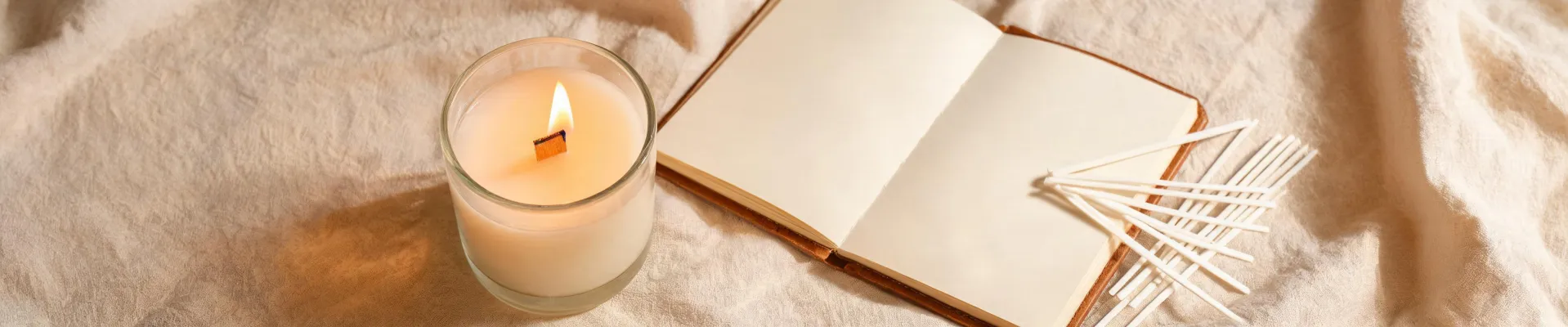
The WoodWick medium hourglass candle is a great size for corporate gifting. It's compact enough for a gift box, it feels substantial, and it has a feature no other candle I've given has: a wooden wick that crackles while it burns. That sound changes the whole experience. It's not just a candle—it's a tiny fireplace on someone's coffee table.
That novelty drives brand recall better than any logo placement. Every time the recipient lights it, they're reminded of who sent it. It burns for a decent number of evenings, so it's a lot of impressions from one gift.
But ordering the right product is only half the battle. The other half is the process behind it, and that's where the real pitfalls hide.
Operational details that make or break an order
If you're thinking about using WoodWick candles as branded merchandise for your own clients, here's what I wish someone had told me three years ago.
Where to buy matters more than you think
If you're asking yourself "WoodWick candles—where to buy them for a corporate order?" the answer isn't the local mall. For bulk orders, you need an authorized distributor or a promotional products company that carries WoodWick. A proper distributor handles volume pricing, custom label application, and logistics. They also know the product line, so you don't end up with the wrong lid or the wrong scent.
In 2021, we tried to save money by ordering through a reseller we found online. The candles arrived with no manufacturing codes on the jars and peeling labels. We'd already shipped 150 of them before our warehouse manager noticed the wax color varied from batch to batch. Replacing them cost $890 and a one-week delay. That was not a bargain.
Shipping: heavy jars, fragile contents
Scented candles are heavier than they look, and glass jars break. When you're sending a candle to 200 or 300 recipients, freight becomes a major line item. The USPS raised its First-Class letter rate to $0.73 in January 2025, and while a candle certainly isn't a letter, it's a reminder that shipping costs keep climbing. We now case-pack candles until the final mile and always do a trial shipment of three units to ourselves before sending out a full wave. Nothing ruins a corporate gift faster than a jar shattered in transit.
Labels, colors, and the Delta E trap
If you're adding a client's logo to a candle label, don't approve colors from a PDF. I learned this the hard way: I once approved a "festive red" label over email for a holiday gift set, and the printed labels came back pink. Industry standard for brand-critical colors is Delta E 2 or less, meaning the printed color should match the target closely enough that most people can't tell the difference. My approval process hadn't used a Pantone reference at all. That's how we ended up with 200 gifts in what I can only describe as maroon-adjacent pink—no, let's be honest, it was just pink.
Now we require a physical proof for any custom label. If a client has a specific brand color, we ask for a Pantone code. I'd rather pay for a proof than reprint 200 labels.
The holiday figurine mistake
Another pitfall: adding a decorative "extra" to make a gift feel more premium. In September 2022, we added a holiday figurine to our December gift boxes—a small decorative piece to accompany the candle. The vendor sent photos, and the figurine looked fine on a screen. In person, it looked like something from a dollar store in 2009. We had to pull it from the lineup, but not before the vendor produced 300 of them. That cost us $890 in wasted production and a week of delays.
The lesson: never approve a new gift component from a photo. Order a physical sample.
A small tip that wins clients over
After a candle is fully burned, clients ask: how to remove leftover wax from candle jar? This is a good question, and knowing the answer makes you look helpful. The easiest method: put the jar in the freezer for a few hours. The wax shrinks as it freezes, and you can pop it out with a butter knife. Wash the jar, and the recipient has a reusable glass container. It's a tiny thing, but recipients remember when your team is actually helpful after the sale.
What if a client doesn't want candles?
The pushback on candles is predictable: "What if the recipient has allergies? What if the office bans scented products? What if they just don't like candles?" Fair questions.
First, we offer scent options. WoodWick's lineup includes lavender, sandalwood, vanilla, coastal scents, and seasonal releases. We rotate based on the time of year, the client's brand colors, even the recipient's department. That flexibility is why I don't treat candles as a one-size-fits-all answer.
Second, even when the candle itself isn't a fit, the jar gets a second life. It becomes a planter, a pen holder, a makeup brush organizer. The product is useful twice, and that's worth something.
But honestly? The crackling wick wins over most skeptics. We've had clients who received a WoodWick candle as a gift come back and order the same candles for their own employees. You never get that from a branded pen.
The bottom line
The fundamentals of corporate gifting haven't changed: it's about making someone feel recognized.
What has changed is execution. In 2025, a logo isn't enough. A quality gift that fits into someone's life—that's the new standard. WoodWick candles work because they're not passive. The sound, the scent, the warmth, and the reusable jar: the gift keeps giving long after the budget line item is closed.
I still make mistakes. Last quarter, I approved a label typo that cost $450 to reprint. But the systems are in place now: physical samples, Pantone references, trial shipments, and a pre-shipment checklist. In the past 18 months, that checklist has caught 47 potential errors. Forty-seven gift disasters that never reached a client.
Buy smarter. Order samples. Verify everything. And choose gifts people will actually use—because they'll remember who sent them.

Elise Laurent
Elise Laurent is a crystal and decorative glass quality analyst covering crystal figurines, vases, ornaments, suncatchers, and gift glassware. She examines ISO 6486-1 where food-contact glass dinnerware applies, then uses polarized strain inspection, dimensional checks, surface-defect grading, and refractive clarity to compare decorative pieces outside that scope. Her work helps sourcing teams choose materials, finishing routes, and protective packaging without confusing visual brilliance with verified durability.