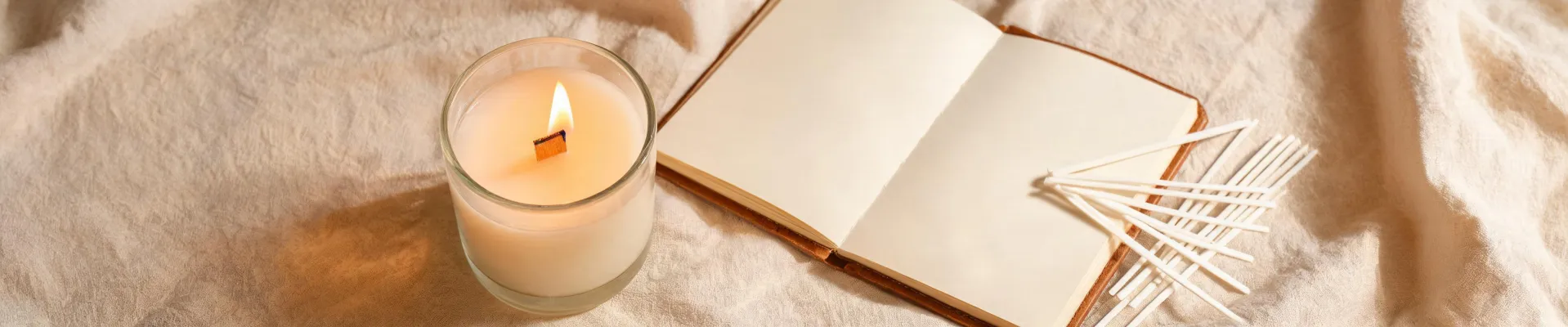
WoodWick vs. Traditional Jar Candles: A Quality Inspector's Total-Cost Comparison
2026-08-04 / Elise Laurent
For the last four years, I've been the person who reviews every candle order before it ships to corporate clients. Roughly 200 unique gift items pass through my inspection annually—burn tests, wick measurements, fragrance load checks, packaging integrity. I've rejected 8% of first deliveries this year. So when a procurement team asks whether to order WoodWick or stick with traditional jar candles, I don't give them a brand pitch. I give them a comparison framework.
The question isn't "which is better." It's "which delivers more value for your specific gifting scenario?" I compare across four dimensions: burn experience, fragrance quality, total cost of ownership, and consistency. Here's what four years of inspections have taught me.
Burn Experience: Silence vs. Subtle Drama
The most obvious difference is the wooden wick. WoodWick candles crackle—gently, continuously, like a miniature fireplace. I've sat through dozens of product demonstrations where first-time users light one and their entire demeanor shifts. They lean in. They smile. It's a sensory hook that cotton wicks don't have.
There's nothing wrong with a traditional cotton wick jar candle. It burns predictably, it's quiet, and it does what it's supposed to do. In some settings, quiet is preferable—spa environments, executive offices, wellness centers.
But watching recipients open corporate gifts, I've noticed the crackle creates a moment. Someone opens the box, lights a WoodWick Ellipse, and suddenly they're not just receiving a candle—they're experiencing it. It's kinda like the difference between a generic pre-printed notepad and a personalized embossed one. Same function, different impact.
From a QC standpoint, wooden wicks need more precise trimming (1/8 inch is the sweet spot). Too thin, and the wick drowns in wax. Too thick, and it smokes. The margin for error is narrower than cotton, but when manufactured correctly, the burn is remarkably stable.
Fragrance Quality: The Real Test
Fragrance throw is the metric that matters most in my line of work. Cold throw (how a candle smells unlit) is easy to achieve—you just load up the top layer of wax. Hot throw (how the scent fills a room when burning) requires proper fragrance load throughout the entire candle and a wax blend that releases scent at the right temperature.
The WoodWick Ellipse line consistently tests well on hot throw. In our standardized 12x12 room test, most Ellipse candles produce a noticeable fragrance at 8–10 feet within 20 minutes of lighting. That's solid performance.
Traditional jar candles vary more between batches, which is both a risk and an opportunity. A well-made jar candle with the right fragrance-to-wax ratio, correct wick sizing, and adequate cure time can fill a room just as effectively. But I've seen shipments where the first 100 units smelled different from the rest—same SKU, same vendor, different result. That's why we test in batches, not just single samples.
Per FTC advertising guidelines, claims like "long-lasting fragrance" or "premium scent" must be truthful and substantiated. So when a vendor says their candle has "the strongest throw on the market," I ask for their test data. Surprisingly few can produce it. WoodWick has been among the more responsive in providing third-party testing results, which I appreciate from a compliance standpoint.
Total Cost: Don't Just Look at the Price Tag
Here's where I lose clients who shop purely on unit price. A WoodWick Ellipse costs more upfront than a comparable traditional jar candle. I won't pretend otherwise. But I've watched "cheaper" candles rack up hidden costs that erase the savings.
In Q3 of 2024, we sourced 3,000 jar candles from a lower-cost vendor. The unit price looked great—about 30% below our usual spec. Here's what the spreadsheet missed:
- Breakage rate: 4.2% arrived cracked or with loose lids, versus 1.1% for our primary vendor. That's 126 damaged units requiring replacement.
- Fragrance inconsistency: 9% of the batch failed our hot throw test. Same SKU, different fragrance output.
- Expedited reorder: $6,800 for a rush order to replace the rejected units.
- Client credits: Two clients noticed. We issued $2,100 in goodwill credits (the worst kind of expense—one that comes with a difficult conversation).
The "cheaper" candle ended up costing us 14% more per delivered, accepted unit than the premium option. That's total cost of ownership (TCO) thinking, and it's the framework I use for every vendor decision now.
When I calculate TCO, I use a simple formula: TCO = unit price + shipping + breakage replacement cost + quality rejection cost + expedite fees + client goodwill risk. Not a fancy model, but it captures the categories that matter. After walking our procurement team through this breakdown, they stopped sorting vendors by unit price. They started sorting by delivered, accepted cost per unit. That one change saved roughly $47,000 in 2024 across all product categories, not just candles.
Shipping costs matter too. Per USPS pricing effective January 2025, a First-Class Mail large envelope (1 oz) is $1.50. But candle boxes are usually heavier—Priority Mail territory. Dimensional weight pricing kicks in, and heavier glass jars across a bulk order add real money. I've saved clients thousands by comparing jar weights and dimensions before committing to a vendor.
Consistency: The Surprise Conclusion
Here's the conclusion that surprised me when I started this work: wooden wick candles require more quality control, not less. Natural wood has variance. Wick density, grain, and moisture content differ slightly between batches, and that affects burn behavior.
That's not a knock on WoodWick—it's the opposite. A brand that invests in wooden wick technology usually invests in the QC infrastructure around it. WoodWick, part of the Yankee Candle family of brands (which answers the "Yankee Candle WoodWick" connection people often ask about), has mature consistency metrics. In our last inspection, 96% of WoodWick wicks were within ±0.5mm of spec.
When I implemented our verification protocol in 2022, we ordered a batch of wooden wick candles from a different, cheaper source. Six percent of the wicks were too dense. They lit fine but burned hotter than spec. We caught it in the first-article inspection and rejected the batch. The vendor redid it at their cost, but that experience taught me to include wick density tolerance clauses in every contract.
There's something satisfying about a well-executed compliance protocol. After the chaos of that 2022 shipment, finally having a system where every batch gets measured against objective tolerances—that's the payoff. No more 3am worry sessions about whether the order will pass.
The Rest of the Gift Box
Candles rarely travel alone in corporate gifting. You're usually building a box: candle, a holiday figurine as a seasonal touch, a custom note card, sometimes a craft item. Lately, procurement teams have been adding diamond painting kits as a team-building or client-appreciation option. That leads to a question I hear increasingly often: where to buy blank canvas for diamond painting that meets quality standards?
My answer mirrors what I say about candles: look for cotton canvas with a pre-printed adhesive layer, verify drill count consistency before volume orders, and calculate TCO. A cheaper canvas that loses diamonds in transit—or arrives with misaligned symbols—costs more in replacements and damaged client goodwill than a premium option that arrives ready to use. Same logic, different product.
Which Should You Choose?
I don't do "one is better." I do scenarios.
Choose WoodWick Ellipse candles when:
- You're sending premium gifts to clients or partners and want a memorable unboxing experience. The crackling wick is a conversation starter.
- Your recipients appreciate the sensory difference—people who notice quality.
- You have budget for a higher unit cost without sacrificing quantity.
Choose traditional jar candles when:
- You're ordering for a large event where candles function as table décor more than personal gifts.
- Your recipients prefer silent ambience (spas, executive lounges, quiet environments).
- Order volume is high and unit price is the primary constraint.
And if you're tempted to jump straight to the cheapest quote, do the TCO calculation first. Add shipping, expected breakage, rejection risk, and the cost of a disappointed client. Then compare.
Looking back, I should have pushed for TCO thinking earlier in my career. At the time, everyone wanted the lowest line-item price, and I didn't push back hard enough. If I could redo those early vendor conversations, I'd bring the TCO framework to the table on day one. But given what I knew then—still new to the quality role—my approach was understandable. What matters is that I use it now, and the data backs it up.

Elise Laurent
Elise Laurent is a crystal and decorative glass quality analyst covering crystal figurines, vases, ornaments, suncatchers, and gift glassware. She examines ISO 6486-1 where food-contact glass dinnerware applies, then uses polarized strain inspection, dimensional checks, surface-defect grading, and refractive clarity to compare decorative pieces outside that scope. Her work helps sourcing teams choose materials, finishing routes, and protective packaging without confusing visual brilliance with verified durability.