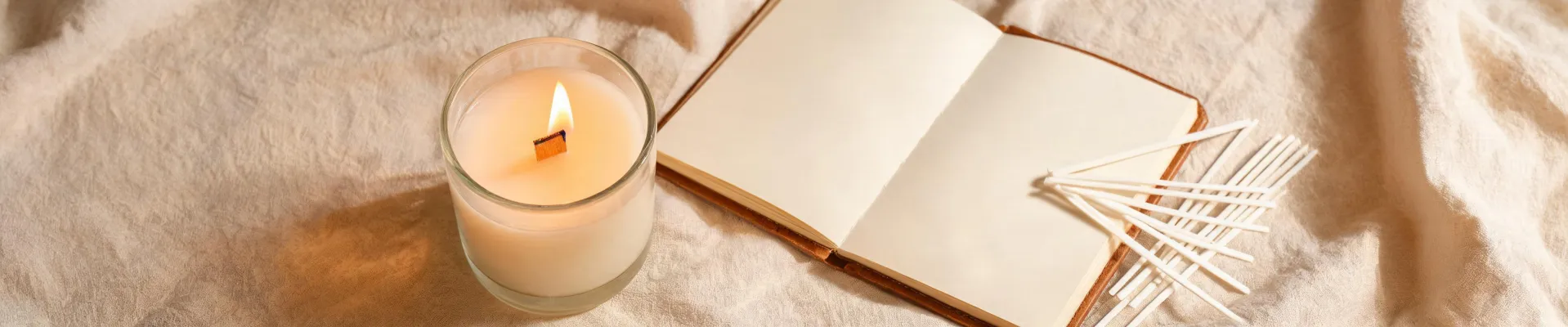
The WoodWick Corporate Gift Checklist: How to Trim Wicks, Pick Sizes, and Avoid a $2,800 Mistake
2026-08-19 / Elise Laurent
-
Step 1: Learn to trim a WoodWick candle before you gift them
-
Step 2: Match the candle size to the gift's job
-
Step 3: Think about the container—holiday figurine editions
-
Step 4: Add something to do with the candle—yes, an embroidery kit works
-
Step 5: Know what corporate gift cards are before you bundle one
-
Step 6: Use the pre-order checklist (the one I now run)
-
Common mistakes I still see (and one I made this year)
If you're the person who gets asked "what should we give our clients this year?"—and the answer you're circling is candles—this checklist is for you. I handle corporate gift orders for a mid-sized professional services firm, and I've been doing it for six years. In that time, I've personally made (and documented) four significant mistakes totaling roughly $2,800 in wasted budget. Now I maintain our team's pre-order checklist. Six steps, about 15 minutes to read, and it applies to client appreciation, employee gifting, holiday hampers, or trade show swag.
Step 1: Learn to trim a WoodWick candle before you gift them
Here's the thing: WoodWick's whole appeal is the wooden wick. The crackle, the way the flame dances, the longer burn. But a wooden wick doesn't behave like a cotton one. It needs to be trimmed to about 1/8 inch (roughly 3 mm) before each burn—not just the first one. If you skip the trim, the flame gets too tall, the wax smokes, and the recipient assumes the candle is defective.
My mistake: In 2021, I ordered 200 WoodWick candles as holiday gifts for client contacts. They arrived smelling incredible, and I shipped them with a generic "Season's Greetings" card. No care instructions. Three weeks later, my inbox was a collection of photos: sooty glass, angry flames, and a guy who said his candle "sounded like a dying campfire." What most people don't realize is that a wooden wick chars into a mushroom shape after burning. That charred tip needs to be snapped off or the wick starves for oxygen.
The trimming routine I now print on every gift card:
- Let the candle cool completely—at least an hour, ideally two.
- Snap off the charred tip. No scissors required; your fingers work once it's cool. WoodWick sells a wick trimmer, but a pair of tweezers is fine.
- Brush any debris out of the wax pool. Loose burnt bits can snuff the flame.
- Trim to 1/8 inch. That's roughly the thickness of a credit card. Too long and you get a tall, smoky flame. Too short and the candle struggles to light.
Here's something vendors won't tell you: most "defective" WoodWick candles are just untrimmed wicks. The product is fine. The ritual wasn't communicated. At least, that's been my experience across the corporate orders we've handled.
Step 2: Match the candle size to the gift's job
I ordered 500 mini WoodWick candles for a trade show in 2023. On paper, it made sense—cheap per unit, easy to hand out, small enough to fit in any tote bag. In reality, a 3-ounce candle burns in about 20 hours, which means it's gone before the recipient even decides where to put it. 500 minis, roughly $1,400, and I overheard a vendor rep at the show ask "what are these again?" Not a single recipient recognized the brand afterward.
The size logic I use now:
- Mini (3 oz, about 20 hours): an add-on, not the headline. Event favors, stocking stuffers, pairings with a larger piece.
- Standard jar (8 oz, about 40 hours): the workhorse for corporate gifting. Enough burn time for the recipient to form a habit, and a lot of brand exposure.
- Large jar (13.75 oz, 60+ hours): VIP clients, executive gifts, milestone celebrations. The oversized crackle is a statement.
Around 120 standard jars would have done more for our brand than 500 minis did. That was a $1,400 lesson—maybe $1,500, I'm mixing in the shipping cost. The point is: know what the gift is supposed to accomplish before you pick the size.
Step 3: Think about the container—holiday figurine editions
WoodWick runs holiday figurine collections every year: candles housed in decorative, collectible containers. If you're planning Q4 corporate gifting, these are worth considering because the vessel outlives the wax. A figurine candle reads as a gift. A plain jar reads as a candle. That's a subtle but real difference in perceived value.
Catch: the figurine lines sell out well before the holidays. In 2022, we started our search in November, and most of the collection was already gone. We ended up with mismatched designs—a decorative figurine line for one set of clients, a plain jar for the others. It looked disorganized. This year, I'm asking about holiday figurine stock in September.
Another consideration: branding. If your logo is going on a label, a standard jar silhouette is easier to wrap cleanly. A figurine with a wonky sticker is a desk-drawer fate. If you need an exact brand color, give your vendor a Pantone reference. Industry tolerance for brand-critical colors is Delta E < 2; anything above 4, your customer will notice the mismatch with their own eyes.
Step 4: Add something to do with the candle—yes, an embroidery kit works
The surprise wasn't the price difference. It was how much engagement came from an $11 addition.
For a remote-team retreat in 2024, we paired a mini WoodWick candle with a small embroidery kit. The theme was "cozy crafting night": light the candle, pick up a hoop, stitch something for an hour. I expected it to be a fine activity. What I didn't expect was the follow-through: people photographed their hoops, shared them in the company Slack, and two teams scheduled their own candle-and-stitch evening.
I should add a caveat: embroidery kits come with needles, which international shipping gets sensitive about, and they add complexity to bulk ordering. They're not for every corporate order. But if your company is exploring wellness gifts or experience gifts, pairing a candle with a tactile activity beats adding a second candle. (Should mention: we tested this with 42 people before scaling it—it worked because the activity was the hook, not the candle.) It worked for our team—at least, for our remote-culture needs.
Step 5: Know what corporate gift cards are before you bundle one
What are corporate gift cards? They look like consumer gift cards, but they're a different animal. A corporate gift card is issued to a business—not to an individual shopper—in bulk. They come with volume pricing, custom branding options (company logo, custom message, sometimes a branded activation URL), and different regulatory treatment. In the US, for example, certain gift card values count as taxable income to the recipient. The EU has its own rules.
My mistake came in January 2024. I ordered branded corporate gift cards to pair with WoodWick candles for a client onboarding program. I spec'd them well: 14pt cardstock (100 lb cover, about 270 gsm), double-sided printing, a Pantone-matched blue band, 300 DPI artwork. They looked excellent. The US standard card size is 3.5 × 2 inches—85 × 55 mm if your European partners expect business-card etiquette.
What I didn't test was the redemption flow. The branded cards required a corporate account, but our activation batch was loaded on the consumer portal, so recipients couldn't register them. The design cost $0.55 per card. The embarrassment was higher. A $520 print order turned into a cross-department fire drill and a hasty e-gift card backup. If you're pairing a gift card with a candle, test the full chain: order, activate, register, redeem. Don't just admire the cardstock.
Step 6: Use the pre-order checklist (the one I now run)
My team's checklist has caught 47 potential errors in the past 18 months. Here's the whole thing:
- Burn one sample end-to-end. Light it, trim it, let the wax pool reach the edges. Note if the wick bends or soots.
- Care instructions included? Does the recipient know how to trim the wick and how long the first burn should be?
- Size, confirmed? Mini as an add-on, standard for clients, large for VIPs.
- Container aligned with your brand? Figurine for warm, personal gifting; plain jars if you need clean logo wraps.
- Production and shipping in writing? "Standard turnaround" is a buffer, not a promise. Get the ship date on the PO.
- Gift cards tested? Activate one, register it, spend it. Verify the entire redemption chain.
- Spot check the boxes. Open 3 out of every 200. Check for cracked jars and bent wicks.
Common mistakes I still see (and one I made this year)
First: storing candles in a warm space. A hot warehouse will soften the wax, bend the wicks, and make the jars sweat. We ruined a batch of holiday figurines in the July heat—that's mistake number four on my record. It cost more in credibility than in product.
Second: skipping the "first burn" instruction. Even with a trimmed wick, the first burn should last long enough—usually 2 to 3 hours—for the whole top layer to melt. If it doesn't, the candle tunnels: wax builds up on the sides and the wick drowns in a pit. Tell your recipients this. It's one sentence on a card, and it prevents 80% of the email complaints I used to get.
Third: not understanding what corporate gift cards actually do. They're a reliable way to offer value, but they're only as good as the activation process behind them. Test the card like you'd test the candle.
The process isn't glamorous. But switching to a formal checklist cut our reorder and reprint rate to zero in 2024—twelve corporate orders, zero redos, zero rushed shipping. In a budget-tight year, that saved us the cost of our next mistake. I'd rather not make it.

Elise Laurent
Elise Laurent is a crystal and decorative glass quality analyst covering crystal figurines, vases, ornaments, suncatchers, and gift glassware. She examines ISO 6486-1 where food-contact glass dinnerware applies, then uses polarized strain inspection, dimensional checks, surface-defect grading, and refractive clarity to compare decorative pieces outside that scope. Her work helps sourcing teams choose materials, finishing routes, and protective packaging without confusing visual brilliance with verified durability.