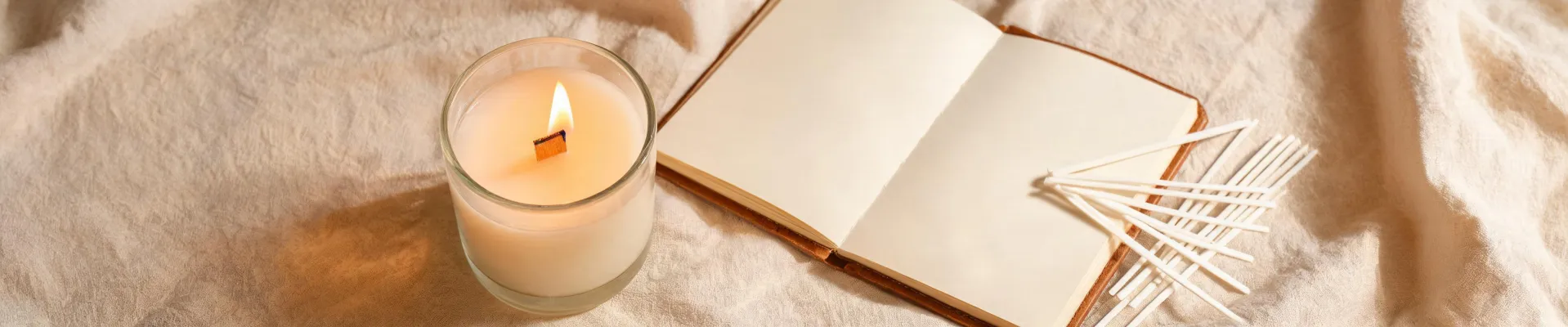
How to Order WoodWick Corporate Gifts Without the Headache: A 5-Step Checklist for Office Buyers
2026-07-30 / Elise Laurent
-
Who this is for
-
Step 1: Define your quantities and timeline before you Google anything
-
Step 2: Verify the vendor's experience with corporate orders — not just retail
-
Step 3: Ask about customization and packaging — the "hidden" variables
-
Step 4: Get the full cost picture — not just the unit price
-
Step 5: Confirm the sample and approval process — don't skip this
-
A few common mistakes to avoid
Who this is for
If you're the person in your company who gets asked to “find a nice corporate gift for 50 clients” or “order something for the holiday party favors” — and you've never bought scented candles in bulk before — this checklist is for you.
I'm an office administrator for a mid-sized company, managing about $150k annually across 8 vendors for office supplies, promotional items, and gifts. When I took over purchasing in 2020, I made every mistake in the book. This is the checklist I wish I'd had.
Here are 5 steps to get it right, starting from the very first inquiry.
Step 1: Define your quantities and timeline before you Google anything
It's tempting to jump straight to comparing candle scents. Don't. The first thing I do now — after being burned — is write down two numbers: how many units I need, and when they need to arrive.
Why this matters: WoodWick gift sets and jar candles come in different packaging configurations. A single 13.2oz ellipse candle is one thing. A gift set with a candle, diffuser, and matches is another. If you need 200 units of a specific set, that might be a custom assembly. Lead times change.
Check these first:
- Exact quantity (round up — it's cheaper to have extras than to reorder)
- Delivery deadline (add 2 weeks buffer if possible)
- Uniform gift or tiered options (exec vs. team gifts?)
I want to say we ordered 500 units for our 2024 launch event, but don't hold me to that exact number — it might have been closer to 400. Point is, know your volume.
Step 2: Verify the vendor's experience with corporate orders — not just retail
Here's the simplification trap: just because a brand sells great consumer products doesn't mean they handle B2B orders smoothly. WoodWick is a well-known brand, but when I buy from them (or through an authorized distributor), I'm not looking for retail customer service. I need someone who understands bulk pricing, net terms, and invoicing.
Questions to ask upfront:
- Do you have a dedicated corporate sales or B2B team?
- Can you provide a quote with line-item pricing and payment terms?
- What's your minimum order for custom packaging or engraving?
In my first year, I made the classic rookie mistake: I assumed “corporate gift” meant the same thing to every vendor. One vendor quoted me for individual retail boxes — no bulk discount, no custom logo option. I had to start over. Cost me about $400 in rush fees.
Step 3: Ask about customization and packaging — the "hidden" variables
A WoodWick candle is a beautiful product on its own. But for corporate gifting, you'll probably want some branding: a custom sleeve, a ribbon, a gift card with your company logo, or even a custom scent combination.
Most buyers overlook this: customization changes the timeline significantly. If your vendor needs to order custom boxes from a third party, that adds 2-4 weeks. If they screen-print the jars in-house, maybe 1 week.
The 'get three quotes' advice ignores the transaction cost of vendor evaluation. I've found it's more efficient to ask one reliable vendor for 2-3 options at different customization levels. For example:
- Option A: Stock product, no logo (fastest, lowest cost)
- Option B: Custom sleeve or sticker with logo (medium)
- Option C: Fully custom packaging + engraved wooden lid (premium, long lead)
Don't assume you need Option C. Most of our clients appreciated a consistent, well-presented gift — they didn't care if the logo was engraved or on a nice tag.
Step 4: Get the full cost picture — not just the unit price
I've learned to ask “what's NOT included” before “what's the price.”
Transparency on pricing is a core principle for me. The vendor who lists all fees upfront — even if the total looks higher — usually costs less in the end. I learned this the hard way.
Typical hidden costs in corporate gift orders:
- Setup fees for custom packaging (digital die, plate, or screen charges)
- Art proofing fees (especially if you need multiple revisions)
- Shipping — especially if it's freight for large quantities
- Rush fees (we've all been there)
- Taxes and duties if shipping internationally
Had to decide on a vendor in under 2 hours once — normal process would have been 3 quotes, but there was no time. I went with the vendor who gave me a single, all-in number. Even though it was 15% higher than the other quote, there were no surprises. The other quote? They added a $300 setup fee and $150 for shipping later.
As of January 2025, typical pricing for WoodWick corporate gifts (stock packaging) ranges from roughly $15–$30 per unit for single candles to $40–$80+ for curated gift sets, depending on volume. Verify current pricing with your vendor, as rates may have changed.
Step 5: Confirm the sample and approval process — don't skip this
I approve a lot of orders based on samples. If you're ordering custom packaging, you need a physical or digital proof. If you're ordering a custom scent blend, you absolutely need a sample.
My rule: Never approve the final order without seeing a sample of the actual product you're buying. Not a photo, not a similar item — the exact item.
In 2022, I approved a custom sleeve design from a PDF proof. Looked great. When the boxes arrived, the color was completely off. The vendor said “the screen calibration…” — cost us $600 to reprint. Now I always ask for a physical sample or at least a photograph under natural light.
For WoodWick corporate orders, here's what to ask for:
- A sample of the candle or gift set (to verify scent, burn quality, and packaging)
- A sample of any custom packaging (sleeve, ribbon, tag)
- A clear timeline of when you'll receive each sample
Even after choosing the vendor, I kept second-guessing our decision on the scent. What if the recipients didn't like it? The two weeks until the sample arrived were stressful. But once I smelled it, I knew it was right.
A few common mistakes to avoid
After 5 years of managing these relationships, here are the pitfalls I see most often:
1. Ordering too many units of one scent. WoodWick has a lot of variety — applewood, lavendar, sandalwood. Don't put all your eggs in one basket. A mix of 3-4 scents works better for a diverse recipient list.
2. Forgetting about the diffuser preference. Some people prefer reed diffusers over candles (no flame, no soot, just continuous scent). If you're ordering a gift set, the reed diffuser vs. electric diffuser debate is real — but for corporate gifts, reed diffusers are more practical. They don't need a power outlet and last 4-6 weeks.
3. Assuming "premium" means "better for everyone." A nativity set or heavily seasonal packaging might not work for all corporate recipients. Stick with neutral, year-round options unless you know the audience.
4. Not having a plan B for shipping. If the vendor's standard carrier can't deliver to your recipient list (especially international or remote locations), ask about alternatives. We had a shipment to a remote office delayed by 3 weeks because the carrier didn't service that area.
5. Neglecting the invoice. This sounds small, but it's the thing that got me into trouble early on. Make sure the vendor can provide a proper invoice with all the details your finance team needs. We had a vendor who could only email a PDF — no line items, no PO number field. Finance rejected it. I ended up spending 2 hours reconstructing the order history.
In the end, ordering WoodWick corporate gifts doesn't have to be complicated. It's about asking the right questions upfront, being clear on your needs, and building a relationship with a vendor who values transparency as much as you do.

Elise Laurent
Elise Laurent is a crystal and decorative glass quality analyst covering crystal figurines, vases, ornaments, suncatchers, and gift glassware. She examines ISO 6486-1 where food-contact glass dinnerware applies, then uses polarized strain inspection, dimensional checks, surface-defect grading, and refractive clarity to compare decorative pieces outside that scope. Her work helps sourcing teams choose materials, finishing routes, and protective packaging without confusing visual brilliance with verified durability.