WoodWick vs. Generic Candles for Corporate Gifts: What I Learned After Testing Both
2026-08-21 / Elise Laurent
When I took over purchasing in 2020, I assumed all candles were basically the same. Pick a scent, slap a logo on the box, write a PO, done. That assumption cost us more than I like to admit.
Our company does around 200 gift orders a year—client appreciation, holiday gifting, new business welcome packages. I manage most of it. Roughly $60,000 in annual spend across maybe 8 vendors, and candles are a recurring line item.
Last fall, my VP asked me to evaluate our candle options for the coming holiday season. 150 units across two offices, plus about 60 wax melt warmers for the new wellness room. I decided to run a proper head-to-head: WoodWick vs. the unbranded generic supplier we'd been using for client touchpoints.
It's tempting to think a candle is a candle. But comparing identical product categories from different vendors side by side made me realize how much the details matter—and how much of my decision comes down to risk management, not just price.
Dimension 1: Unboxing & Perceived Value
The first thing a recipient sees is the box, not the candle.
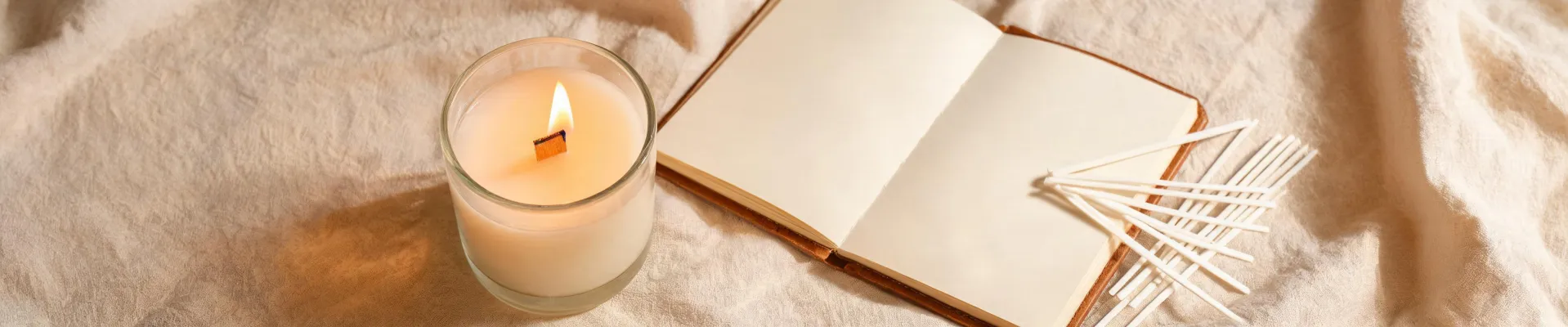
With WoodWick, the packaging does half the selling. The white teak woodwick candle arrives in a sturdy box with clean typography. The wick is visible through the glass—that little wooden slat immediately signals "this is not a drugstore candle." When clients posted photos of our gift on LinkedIn (which happened more than I expected, honestly), the brand was recognizable and it looked good.
Our generic supplier's candles? Fine in the catalog. In real life, the jars were thinner, the labels looked like they were printed on a home printer, and one was actually crooked. A client mentioned it. That's embarrassing.
I'm not saying everyone notices these details. But the people who do tend to be decision-makers, and their impressions shape how they see your company.
Here's the data point that convinced me: our generic candle gifts generated zero mentions on social media. The WoodWick gifts, in the same quarter, generated 4 organic posts. For a corporate gift program, that's free brand exposure.
Conclusion: For corporate gifts, brand presentation is part of the product you're buying. If the gift represents your company, packaging quality affects how the gift—and by extension, your company—is perceived.
Dimension 2: Sensory Experience (Crackle + Scent Throw)
This is where the comparison gets genuinely interesting. I'm not a perfumer, but after five years of testing products for our office, I know what I'm smelling.
The wooden wick in a WoodWick candle isn't a gimmick. It changes the entire sensory experience. Lighting a white teak candle for a client meeting, the wick crackles like a tiny fireplace. I've watched meeting participants stop mid-sentence and glance at the candle. That doesn't happen with cotton wicks.
Scent throw was another differentiator. In a 15-person conference room, the WoodWick white teak filled the space within about 20 minutes—noticeable at both ends of a long table. The generic candle with a similar scent profile? You needed to be within 4 feet. We ran this test three times, with two different generic vendors, same outcome. The scent chemistry just wasn't as well-optimized.
The woodwick fireside wax melts were also the best performers we tested for the wellness room warmers. The smoky, amber-forward profile carried well without being overpowering. The generic melts faded after about 3 hours; the WoodWick versions held for closer to 6.
Now, the caveat: not everyone loves the crackle. If the recipient works in a quiet, noise-sensitive space—say, a home office used for video calls—the crackling can be distracting. That's a niche concern, but I flagged it in our recommendation notes.
Conclusion: WoodWick delivers a markedly stronger and more distinctive sensory experience. But "distinctive" isn't the same as "universally preferred"—know your recipient's environment.
Dimension 3: True Cost & Logistics
This dimension surprised me the most.
The unit math is straightforward: WoodWick candles run roughly $25-35 per unit depending on size and scent (based on vendor quotes as of January 2025—verify current pricing). The generic supplier quoted $8-12 per unit. On paper, no contest.
But the numbers changed once I factored in everything else.
Complaints and reorders: We shipped 80 generic candles to clients in October. 17 complaints about weak scent. That triggered 10 replacement orders, plus follow-up emails and reshipping costs—roughly $300 in replacement inventory and shipping, and about 8 hours of staff time. Our finance team tracks these costs, and this part of the spreadsheet belongs to me, not the vendor.
Lead time reliability: The generic supplier missed two quoted delivery dates. In my world—where I report to both operations and finance—a missed date isn't a minor inconvenience. It's me in a meeting, explaining why a client's gift arrived after their event.
Perceived value gap: Clients assume a premium candle costs $35-45. They assume a generic candle costs $5. I can't prove this with a data point, but perception is the currency of corporate gifting.
At the end of the year, I did a rough calculation. The raw price gap was about $1,600 on 150 units. The hidden costs—replacements, staff time, expedited shipping, my own headache hours—ate up nearly $900 of that gap. And the remaining $700 difference bought us a significantly better brand impression and zero complaints.
Conclusion: The "cheaper" option is often more expensive when you factor in complaints, replacements, and management overhead. For a one-off, maybe generic makes sense. For a recurring program, consistency wins.
Dimension 4: Personalization & Custom Branding
We needed custom labels on all 150 boxes. This was a hard requirement from our marketing team.
WoodWick handled it cleanly: proof within 3 business days, printed labels that looked like they belonged on the product, and our first batch shipped within 10 days of final approval. If you're looking for a personalized gift at scale, that kind of turnaround is the difference between a smooth season and a stressful one.
Our previous generic vendor took 2 weeks just to respond to the customization request. When the samples arrived, the printing was misaligned. One of the marketing associates said it looked "like a sticker on a bargain bin candle." Harsh, but accurate.
Conclusion: If personalization carries your brand, it needs to look integrated with the product. That alone is worth a premium.
A Quick Tangent: The Nativity Scene Question
Since I'm on the topic of holiday requests: our facilities team asked me how to set up a nativity scene in the office lobby. They wanted candlelight around the display.
I steered them to wax melts instead. Open flames near straw, aged wood, and fabric displays is exactly the kind of risk I don't take. One tipped candle in an empty lobby is how small problems become big ones. So we kept the nativity scene as the visual anchor and placed two warmers with fireside wax melts on side tables nearby—out of the footpath, away from the display. Same warm, contemplative glow, zero fire hazard.
If you're setting up a nativity scene and want the candlelight effect without the risk, that's the approach: warmers around the perimeter, not flames inside the display. Dim the overhead lights and the fireside scent does the rest.
When to Choose WoodWick vs. Generic Candles
Let me make this practical.
Choose WoodWick when:
- Gifting to clients, executives, or anyone whose impression of your company matters
- You need zero complaints about scent and quality
- Lead-time reliability and responsive vendor support are critical
- Custom branding must look polished—not like a sticker
- Your budget allows $20-35 per unit
Choose generic when:
- The gift is for internal staff where budget is the primary constraint
- Unit cost must stay under $10
- You have an established supplier relationship with verified quality
- Packaging and brand perception don't matter for the recipient group
This isn't a universal verdict—it's a framework. For us, WoodWick handles the high-touch moments, and we're keeping a mid-tier option for casual internal recognition. Two tiers, two purposes.
The Bottom Line
What I learned from this comparison: you're never just buying a candle. You're buying the impression it creates, the experience it delivers, and the risk you carry if it fails.
The WoodWick white teak candle and fireside wax melts are now permanent fixtures in our gifting rotation. The upfront cost is higher, but the absence of complaints, the organic social media posts from clients, and the clean personalization are worth more than the price difference.
The old version of me would've bought the $8 candles and called it a day. The current version checks the vendor's invoicing, tests the product before committing to volume, and weighs the total cost of ownership. That shift didn't come from a single failure—it came from dozens of small lessons and one memorable $2,400 mistake.
If you're making this decision for your company, don't just compare unit prices. Light both candles. Open both boxes. Run both through your procurement process. Then decide.

Elise Laurent
Elise Laurent is a crystal and decorative glass quality analyst covering crystal figurines, vases, ornaments, suncatchers, and gift glassware. She examines ISO 6486-1 where food-contact glass dinnerware applies, then uses polarized strain inspection, dimensional checks, surface-defect grading, and refractive clarity to compare decorative pieces outside that scope. Her work helps sourcing teams choose materials, finishing routes, and protective packaging without confusing visual brilliance with verified durability.