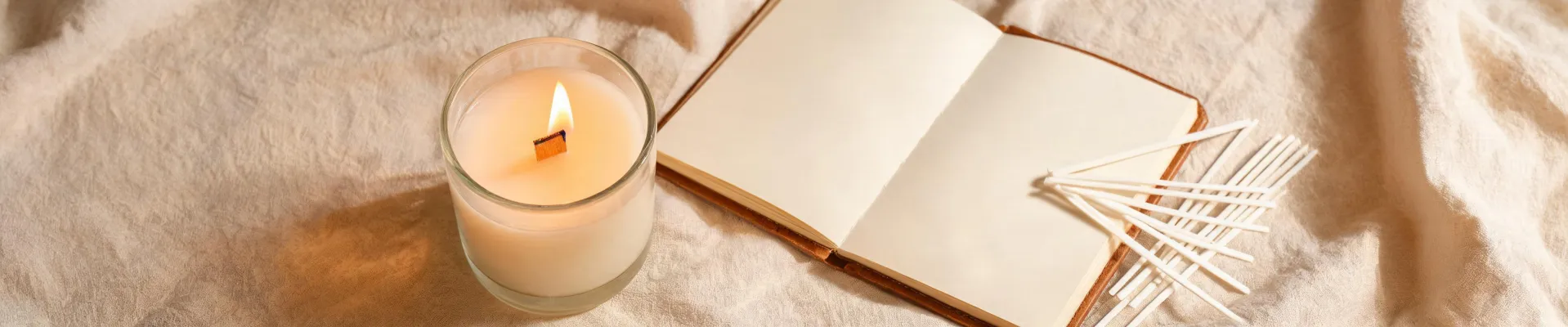
WoodWick Corporate Gift Buying: A 6-Step Procurement Checklist for 2025
2026-08-26 / Elise Laurent
-
If you buy corporate gifts, this checklist is for you
-
Step 1: Lock the recipient list and deadline before looking at products
-
Step 2: Choose the right WoodWick format
-
Step 3: Get a sample and verify the details
-
Step 4: Calculate total cost, not unit price
-
Step 5: Plan shipping and a buffer
-
Step 6: Review labeling and marketing claims
-
Notes: Mistakes I've made so you can skip them
If you buy corporate gifts, this checklist is for you
I'm the procurement manager at a 40-person company. I've managed our promotional products budget — roughly $25,000 a year — for six years, and I've negotiated with 20+ vendors (maybe 25, I'd have to check). This is the checklist I wish I'd had before my first Q4 gift order.
It took me four seasons and about 120 gift orders to understand that the lowest unit price almost never wins. The real cost is the whole chain: product, packaging, shipping, and the occasional reorder when the scent misses. Here are six steps, in the order that works. No clutter.
Step 1: Lock the recipient list and deadline before looking at products
The fastest way to spend money on the wrong gift is to start with products. Start with a spreadsheet: recipient name, tier, shipping address, internal deadline. Then define the quantity. That sounds obvious, but it's the step everyone skips.
I only believed in writing this down after I skipped it once and ordered 300 slate coasters that didn't fit the gift boxes we already had. That mistake cost us a week and a reorder fee.
Checkpoint: you should know exactly how many gifts you need, how many are going to one address versus individual homes, and the last possible ship date.
Step 2: Choose the right WoodWick format
WoodWick's differentiator is the crackling wooden wick. That sound is what people remember. But not every recipient has the same preferences, so I usually split orders by tier.
For executive gifts, I recommend the WoodWick Ellipse scented candle. The shape sits differently on a desk than a standard jar, and the crackle feels more premium. For broad employee gifts, a WoodWick Tempest candle can work, but I'd be careful: Tempest is a smoky, stormy scent. It's not universally loved. Save it for a tier where you know the recipient likes bold fragrances, or skip it and use lavender, sandalwood, or vanilla for the main batch.
If open-flame rules are an issue, a diffuser is the safer route. Reed diffusers don't require lighting anything, and they ship without the same hazard restrictions as candles in some cases. They're a good option for medical offices, dorms, or client sites with strict fire policies.
What about a Christmas ornament? I love the idea, but don't put a candle and a glass ornament in the same box. Wax and fragile ornaments are a breakage risk, especially in winter shipments. Order ornaments separately and pair them at the packing stage, or use an insert tray.
Step 3: Get a sample and verify the details
A product photo is not a product. I once skipped a sample because the catalog image was beautiful. The actual scent smelled like artificial vanilla, not the warm vanilla we'd expected. We had to reorder with a different fragrance.
Ask for a physical sample or a verified scent note sheet before you commit. This also applies to color matching. Someone on your team might ask, 'Can I find paint color by VIN number?' That's a car thing. For branded gifts, the equivalent is a Pantone chip or a physical color swatch from the ornament or label supplier. Don't trust a screen.
While you're at it, check the exact product code. The WoodWick website is the source of truth for scent names, sizes, and lid finishes. If your vendor's code doesn't match, ask why before you pay.
Step 4: Calculate total cost, not unit price
This is where I see most budget overruns. The quoted unit price is only the beginning. The total cost includes:
- Base product price
- Setup fees for logos, labels, or custom packaging
- Shipping and handling, including residential surcharges
- Rush fees if you missed the deadline
- Potential reprint or replacement costs
The surprise wasn't the price difference between our two leading vendors. It was how much hidden value came with the higher quote — support, revisions, and a quality guarantee. Vendor A quoted $18.50 per unit. Vendor B quoted $16.20. I almost went with B until I calculated TCO. B added a $2.10 setup fee, a $120 freight charge on the invoice, and charged extra for the scent labels we wanted. A's price included all of it. That's a 12% difference hidden in fine print.
Never expected the 'cheap' option to cost more. Turns out it did, because the $2.10 setup fee applied to three separate product lines. I now require vendors to quote with all fees on one page.
Step 5: Plan shipping and a buffer
For corporate gift orders, shipping timing matters more than product lead time. If the candles arrive on December 23, the gift is late no matter how good it smells.
According to USPS, holiday shipping deadlines are set each year on usps.com/holiday-shipping-deadlines. As of January 2025, the First-Class Mail letter rate is $0.73, and large envelopes are $1.50. But you're likely shipping boxes of candles, not letters. So look at the package deadlines, not the stamp rates.
For quantities over 25, I use ground freight and add at least two business days of buffer. That saved us last year. (Should mention: we also built in a 3-day buffer at the end, and we needed every hour of it.) If you're ordering WoodWick Ellipse scented candles for 100 clients, don't assume production and delivery will stack cleanly. Production can take 5–7 days, and freight can take another 3–5. That's two full weeks before gifts are in hand.
Step 6: Review labeling and marketing claims
Before you print a catalog page or send a launch email, get the claims reviewed. Per FTC guidelines on advertising, claims need to be truthful and substantiated. And per the FTC Green Guides, say nothing about eco-friendliness unless you can verify it.
If your company wants to describe WoodWick products, stick to product facts. They have wooden wicks, they crackle, and they come in specific scents. Don't invent 'health benefits' or vague 'toxin-free' labels unless you have documentation. This is also a brand safety issue. You don't need to attack other candle companies. Just say what this product is.
Notes: Mistakes I've made so you can skip them
First, ordering the trendiest scent for everyone. I did that with a fall seasonal collection and heard complaints for months. Broad audiences get lavender, sandalwood, or vanilla. The WoodWick Tempest candle belongs in the 'bold' tier, not the main list.
Second, mixing fragile gifts in one box. A candle and a glass Christmas ornament look lovely in a mockup but not when they arrive as a box of glitter and broken glass. Pack them separately or use an insert tray.
Third, waiting too long. What was best practice in 2020 might not work in 2025. The fundamentals haven't changed — know your recipient, verify the product, calculate total cost — but freight capacity and production lead times have. Start your WoodWick order between late September and early October if you're shipping for Christmas. That's not an exaggeration. It's a procurement habit.
At least, that's been my experience with corporate orders between 25 and 500 units. Larger or smaller orders come with different math, so adjust from there.

Elise Laurent
Elise Laurent is a crystal and decorative glass quality analyst covering crystal figurines, vases, ornaments, suncatchers, and gift glassware. She examines ISO 6486-1 where food-contact glass dinnerware applies, then uses polarized strain inspection, dimensional checks, surface-defect grading, and refractive clarity to compare decorative pieces outside that scope. Her work helps sourcing teams choose materials, finishing routes, and protective packaging without confusing visual brilliance with verified durability.